

Being named successor trustee usually happens at the worst possible time: right after losing a parent, a spouse or someone close. Then the paperwork arrives, and it can feel like everything is urgent. Most of it isn’t. This guide walks through the first 90 days as a Pennsylvania trustee in order, so you know what needs attention this week, what can wait a month, and when to bring in help with managing the trust’s investments.
Every trust is different, and your trust attorney should guide the legal steps. Think of this as a map for the conversation, not a substitute for it.
First, not everything is urgent
A few things do have deadlines: a notice to beneficiaries within 30 days, and an inheritance tax discount that ends at three months. Almost everything else rewards patience. The most common early mistakes are moving too fast: selling investments, closing accounts or making distributions before the full picture is clear.
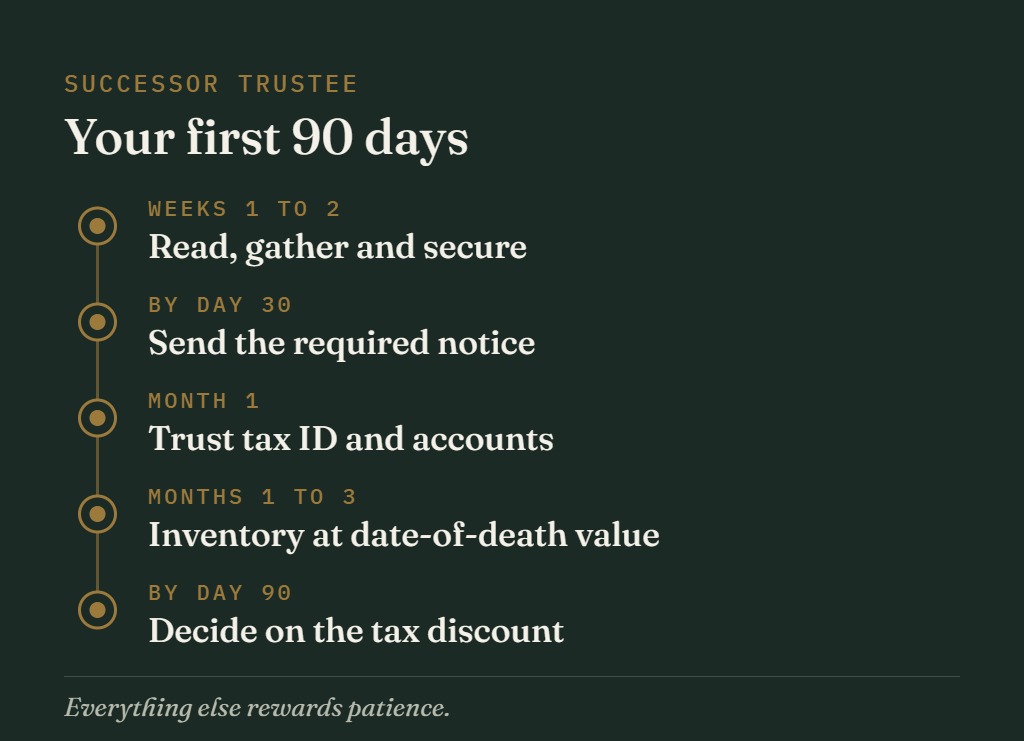
Weeks 1 and 2: read, gather and secure
- Read the whole trust document. Not just the page with your name on it. Note who the beneficiaries are, when and how they receive money, any instructions about investments and whether there’s a co-trustee.
- Get certified copies of the death certificate. Banks, custodians and insurers will each want one. Ten is a reasonable starting number.
- Engage a trust attorney. Ideally one who handles Pennsylvania trust administration regularly. The trust can usually pay reasonable legal fees.
- Find and secure the assets. Gather recent statements, deeds, insurance policies and account logins. Keep property insured and bills paid. Don’t close or move accounts yet.
Within 30 days: the notice Pennsylvania requires
Pennsylvania requires trustees to notify certain people when a trust’s settlor dies. Under 20 Pa.C.S. § 7780.3, when the settlor of a revocable trust dies, the trustee has 30 days to send written notice to the personal representative, the surviving spouse, the settlor’s adult children (and guardians of minor children) and the current beneficiaries. A similar 30-day notice goes to current beneficiaries when the settlor of an irrevocable trust dies, or when trusteeship changes hands.
The notice has required contents, including the trustee’s contact information and each recipient’s right to request a copy of the trust document and annual financial reports. Your attorney will usually prepare and send it, so raise it in your first meeting.
Month 1: give the trust its own paperwork
- A tax ID for the trust. Once the settlor dies, a revocable trust typically becomes irrevocable and needs its own employer identification number (EIN) from the IRS. Your attorney or CPA can apply for it.
- Accounts in the trust’s name. Trust money belongs in accounts titled to the trust, with you signing as trustee. Never mix it with your own money, even briefly.
- A CPA who does fiduciary returns. The trust may need to file federal and Pennsylvania fiduciary income tax returns, separate from the settlor’s final personal return.
Months 1 to 3: take inventory and value everything
List every asset the trust owns and record its value as of the date of death. Those date-of-death values matter twice: for Pennsylvania inheritance tax, and for the trust’s cost basis on investments, which often resets to the date-of-death value for income tax purposes. Custodians can usually provide date-of-death statements for investment accounts. Real estate and business interests may need a formal appraisal.
By month 3: the inheritance tax decision
Pennsylvania taxes inheritances based on who receives them: 0% for a surviving spouse, 4.5% for children and other lineal heirs, 12% for siblings and 15% for most others. Assets in a revocable trust are generally included. The return is due nine months after death, but tax paid within three months earns a 5% discount, so the three-month mark is worth putting on your calendar now.
For a fuller explanation, see our plain-English guide to Pennsylvania inheritance tax, and confirm the numbers for your trust with your attorney or CPA.
Don’t rush the investments, but don’t ignore them
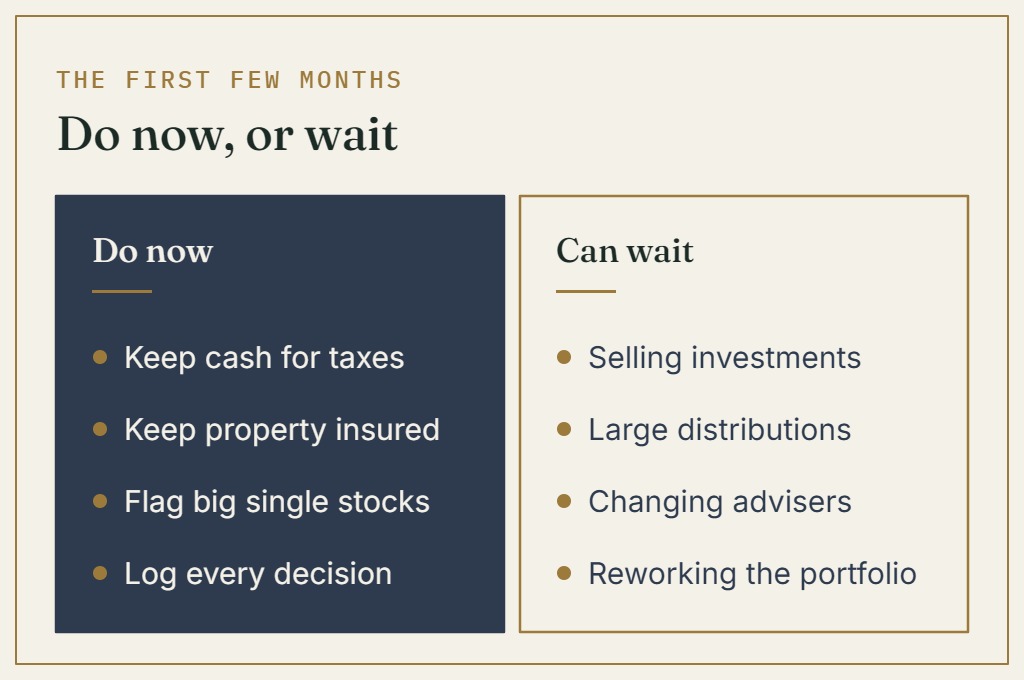
Your first investment job is to make sure the trust has enough cash on hand for taxes, legal fees and expenses over the next year, so nothing has to be sold at a bad moment. After that, look for the obvious risks: a large position in one stock, cash sitting idle or investments that no longer match what the trust document asks for.
Bigger decisions can wait until you have the inventory, the tax picture and a written investment plan. Pennsylvania’s prudent investor rule judges the portfolio as a whole, and it judges the process as much as the outcome. It also lets you hand day-to-day management to a professional. Here’s what that involves, and what you still own.
Hold off on large distributions
It’s natural to want to get money to family quickly. But if you distribute before taxes, debts and expenses are settled, you may have to ask for some of it back, and a trustee can be personally responsible for a shortfall. Small distributions for real needs are often fine. Ask your attorney before anything large.
Keep records from day one
Keep a simple log: every deposit, payment and decision, with the date and a sentence on why. Save statements, invoices and emails with your attorney and CPA. Beneficiaries can ask for reports, and good records make those requests easy instead of stressful.
After day 90
By the end of the first three months, you should have the notices sent, the trust’s accounts and tax ID set up, a full inventory and a plan for the inheritance tax. From there, the job settles into a steadier rhythm: managing the investments, making distributions under the trust’s terms and keeping beneficiaries informed. For the bigger picture of the role, see how a trustee works.
I manage my own family’s trust, and I remember how much of the early work was simply figuring out what came first. If you’re a Pennsylvania trustee working through these first months, I’m glad to help with the investment side, alongside your attorney and CPA.
Common questions
Do I have to accept the job of trustee?
No. A person named as trustee can decline. Under Pennsylvania law, someone who doesn’t accept within a reasonable time is generally treated as having declined. Talk to the trust’s attorney before you take any action on the trust’s behalf, because acting can count as accepting.
Can I be paid for serving as trustee?
Often, yes. Pennsylvania generally allows reasonable compensation unless the trust document says otherwise. Many family trustees choose not to take a fee, and trustee fees are taxable income, so it’s worth discussing with your CPA.
Does the trust have to go through probate?
Assets titled in the trust’s name generally pass outside probate. Anything still in the settlor’s own name may need to go through the estate, so your attorney will check how each asset was titled.
This article is for general educational purposes and is not legal, tax, or investment advice. Trustee duties are governed by state law and the terms of each trust; consult a qualified estate planning attorney about your specific obligations. Investment advisory services are offered by Reese Legacy Capital, LLC only in states where it is properly registered or excluded or exempted from registration requirements. For complete disclosure, refer to Reese Legacy Capital’s Form ADV Part 2.