

If you’ve just been named trustee and the investing part feels out of your depth, you’re not alone, and you’re not stuck doing it yourself. Pennsylvania law lets a trustee hand day-to-day investment management to a professional. What it doesn’t let you do is hand off the responsibility entirely. This guide covers what the law allows, what stays with you, and how to set up investment management for a trust so it holds up if anyone ever asks questions.
The short answer: yes, and Pennsylvania says so in writing
Pennsylvania’s prudent investor rule, in Chapter 72 of Title 20, spells it out directly: “A fiduciary may delegate investment and management functions that a prudent investor of comparable skills might delegate under the circumstances.” That’s 20 Pa.C.S. § 7206(a).
That permission is newer than many people realize. Before the rule took effect in 1999, Pennsylvania case law had generally treated delegating discretionary investment authority as off limits for fiduciaries. Today it’s an accepted, expected option, especially when the trustee is a family member rather than a professional.
Hiring help isn’t shirking the job. Pennsylvania holds trustees to the standard of a prudent investor, and a prudent person without investment experience would bring in someone who has it.
What you still own as trustee
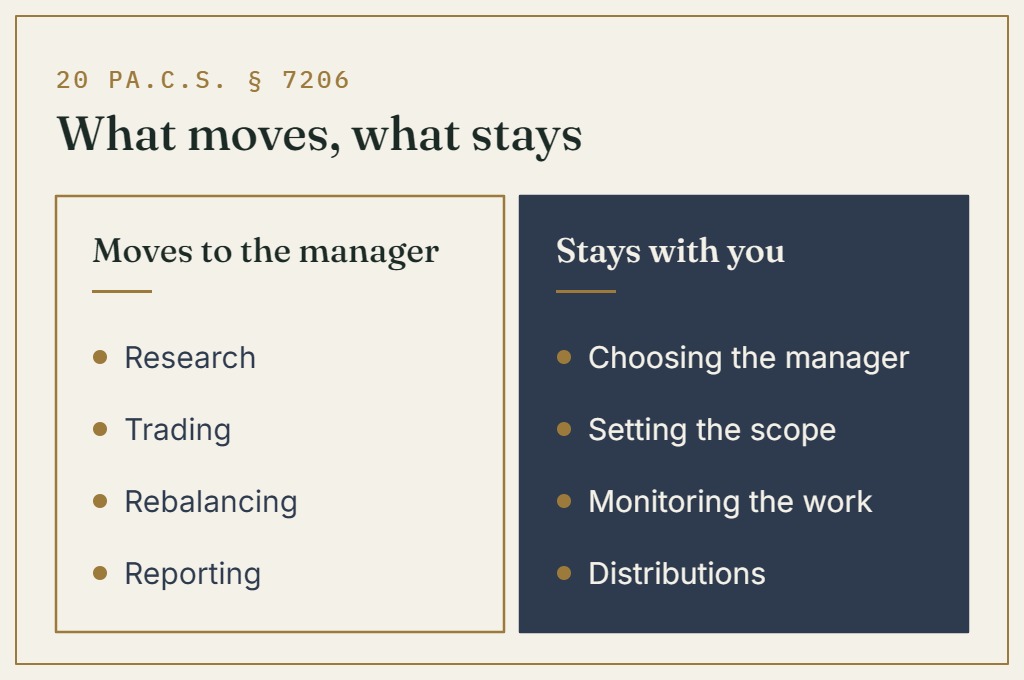
Delegation moves the day-to-day work. It doesn’t move your oversight. Under § 7206, a trustee who delegates is expected to use reasonable care in three things:
- Choosing the manager. Look at their experience with trusts specifically, how they’re paid, and whether they’ll act as a fiduciary.
- Setting the scope and terms in writing. What the manager can and can’t do, consistent with the trust’s purposes and terms.
- Monitoring the work. Reviewing reports and results periodically, and asking questions when something doesn’t line up with the plan.
The payoff for doing those three things well is real. A trustee who uses reasonable care in selecting, instructing and monitoring the manager generally isn’t personally liable for the manager’s individual decisions. The duty shifts from “make every investment call” to “choose well and keep watch.”
What the adviser takes on
The law puts duties on the manager too. Under § 7206(c), an investment agent “shall comply with the scope and terms of the delegation and shall exercise the delegated function with reasonable care, skill and caution and shall be liable to the trust for failure to do so.”
Two more details work in the trustee’s favor. A manager who accepts a delegation from a Pennsylvania fiduciary submits to the jurisdiction of Pennsylvania courts, whatever their agreement says. And a registered investment adviser also owes its clients a fiduciary duty under securities law, which means putting the client’s interests first.
A mutual fund isn’t a delegation
One distinction trips people up. Buying a mutual fund for the trust doesn’t count as delegating. Section 7206(f) says so directly: the fund and its adviser are not the trust’s investment agent.
In practice, that means a trustee who fills the account with funds is still the one making the investment decisions: which funds, in what mix, and when to change them. If you want someone else making and documenting those decisions for this trust, that takes an actual delegation to a manager, under a written agreement.
What a good delegation agreement covers
Your trust attorney should review any agreement before you sign it. These are the pieces worth looking for:
- Scope of authority. Whether the manager has discretion to trade, and any limits the trust document or you want to set.
- An investment policy statement. The trust’s goals, time horizon, income needs, risk limits and how income and remainder beneficiaries are balanced.
- Custody. Assets held in the trust’s own name at an independent custodian, which sends statements to the trustee directly.
- Reporting. How often you’ll receive reports, and whether they separate principal from income.
- Fees. What you’ll pay, how it’s calculated and what it covers.
- Coordination. Permission for the manager to work with the trust’s attorney and CPA.
- Termination. How either side can end the arrangement, and what happens to the account if they do.
Red flags when choosing a manager
- A model portfolio for everyone. A trust with a current income beneficiary and a remainder beneficiary 30 years younger needs more than a standard risk-score allocation.
- No written reasoning. If the manager can’t explain decisions in writing, you’ll have nothing to point to if your judgment is questioned.
- Commissions or product sales. Ask plainly how they’re paid. Fee-only advisers are paid only by their clients.
- No answer on income versus remainder. Ask how they’d balance the two. A vague answer is a real answer.
- Taking custody themselves. The trust’s assets belong at an independent custodian, in the trust’s name.
How it works day to day
Once the arrangement is in place, the manager handles research, trading and rebalancing within the agreed scope. The custodian sends account statements to you directly, and the manager sends reports on top of that. A good rhythm is a quarterly look at the reports, an annual review of the investment policy statement and a conversation whenever the trust’s needs change, such as a beneficiary’s circumstances or a large distribution.
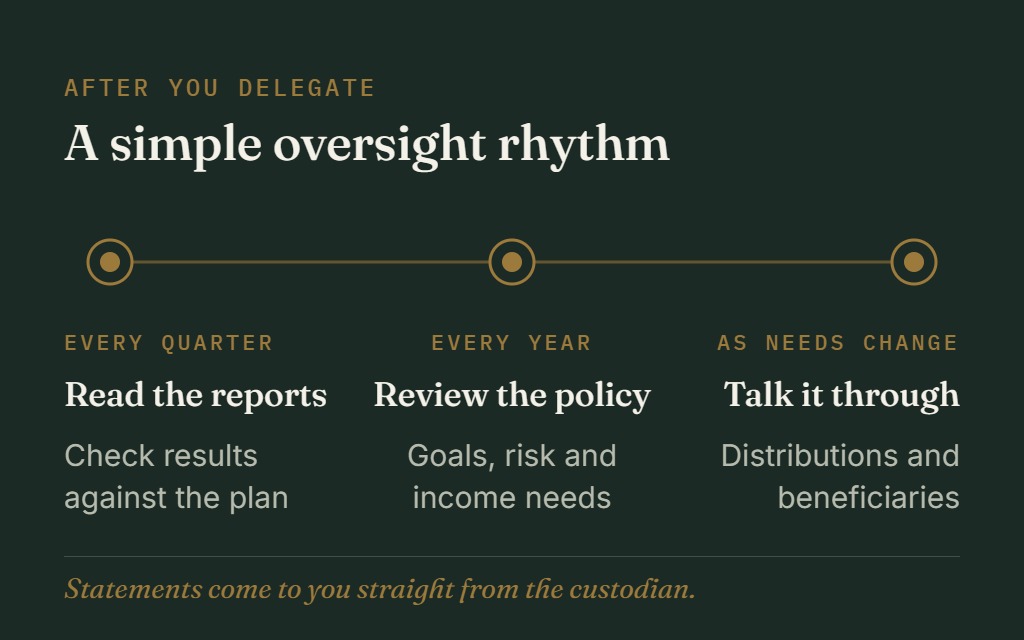
Distribution decisions usually stay with you as trustee. The manager’s job is to make sure the portfolio can meet them.
Check your trust document first
Pennsylvania’s rules are defaults. A trust document can expand, limit or replace them, for example by requiring a certain type of manager or by naming someone other than the trustee to direct the investments. That last arrangement is called a directed trust, and it works differently from delegation. Read your trust document with your attorney before you hire anyone.
Where to start
If you’re a Pennsylvania trustee weighing this decision, begin with the trust document, a conversation with trust counsel and a short list of managers who work with trusts every day. For more on the standard your manager should be working to, read what the prudent investor standard requires, or see how a trustee works for the bigger picture of the role.
I manage my own family’s trust and built Reese Legacy Capital to offer that same care to other trustees. If you’d like to talk through a trust you’re responsible for, I’m happy to walk through what a delegation could look like, alongside your attorney.
Common questions
Does hiring an investment manager protect me from liability?
It helps, if you do it with care. Pennsylvania’s rule expects a trustee to choose the manager carefully, set the scope in writing and monitor the work. A trustee who does those things generally isn’t liable for the manager’s individual decisions. Your attorney can tell you how that applies to your trust.
Can the trust pay the manager’s fee?
Reasonable investment management fees are generally a trust expense. The trust document and Pennsylvania’s principal and income rules determine how they’re charged, so confirm the details with your attorney or CPA.
Do I have to use the adviser the person who created the trust used?
Usually not, unless the trust document requires it. Many successor trustees review the existing arrangement as part of their first 90 days and decide whether it still fits.
This article is for general educational purposes and is not legal, tax, or investment advice. Trustee duties are governed by state law and the terms of each trust; consult a qualified estate planning attorney about your specific obligations. Investment advisory services are offered by Reese Legacy Capital, LLC only in states where it is properly registered or excluded or exempted from registration requirements. For complete disclosure, refer to Reese Legacy Capital’s Form ADV Part 2.