
Eight times a year, the Federal Reserve’s rate-setting committee meets, and eight times a year, headlines declare that the decision “changes everything” for your money. It rarely changes everything. But it does change specific things, in specific ways, for specific parts of a portfolio, and knowing which parts, and why, is what separates a calm response from a reactive one.
This page walks through what actually happens to bonds, cash, and stocks when the Fed moves, and we update it after every meeting so it stays useful whether you’re reading this in September or two years from now.
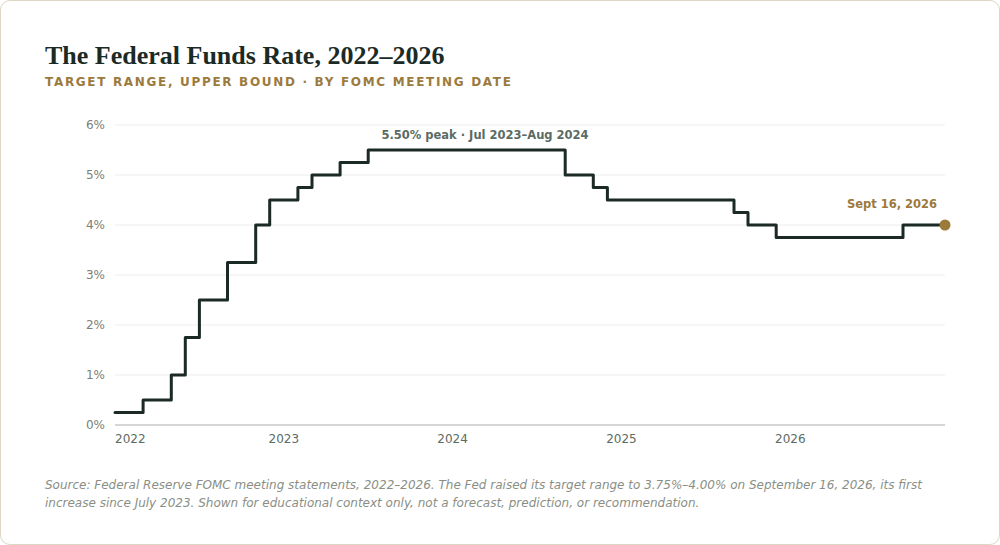
Latest decision, September 16, 2026: The Federal Reserve raised its target rate by 0.25%, to a range of 3.75%–4.00%, its first rate hike since July 2023. Chair Warsh pointed to persistent inflation, worsened by overseas oil-supply disruptions, as the driver behind the move. We’ll update this line after each meeting; the analysis below explains what a move like this typically means for the three parts of your portfolio.
Why the Fed’s rate decisions ripple through every portfolio
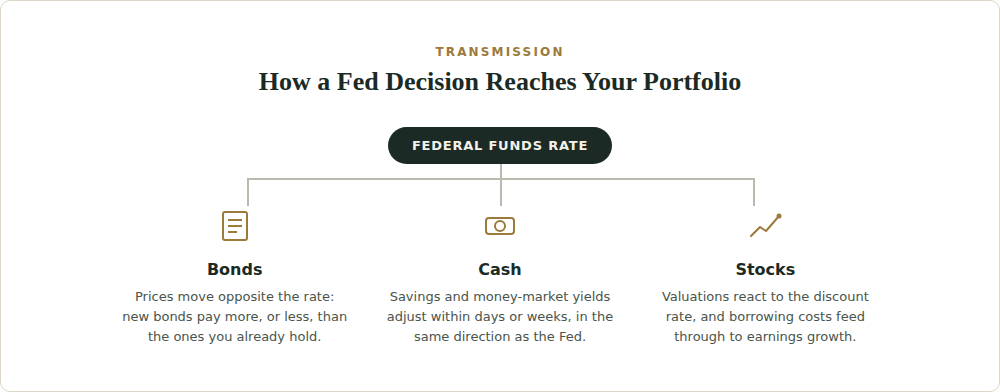
The federal funds rate is the interest rate banks charge each other for overnight loans. It sounds narrow, but it’s the anchor for nearly every other borrowing and lending rate in the economy: mortgages, auto loans, credit cards, savings account yields, and the rates the U.S. Treasury pays to borrow money. When the Fed raises or lowers that one rate, the effect moves outward from there, and it doesn’t move evenly. Bonds, cash, and stocks each respond through a different mechanism, which is why a single Fed decision can be good news for one part of your portfolio and a non-event, or even a headwind, for another.
What happens to bonds when the Fed moves rates
Bond prices and interest rates move in opposite directions. That single relationship explains most of what you need to know.
- When rates rise, newly issued bonds pay more interest than the bonds already sitting in your portfolio. That makes your existing, lower-paying bonds less attractive to other buyers, so their market price drops. If you hold that bond to maturity, you still get your full principal back. The price movement only matters if you sell early or if you’re valuing the portfolio today.
- When rates fall, the reverse happens. Existing bonds that lock in a higher rate than what’s newly available become more valuable, and their prices tend to rise.
- Duration determines how much a bond reacts. A bond maturing in two years barely moves on a rate decision. A bond maturing in twenty years can move a great deal, because far more future interest payments are affected by the rate change.
- New bond purchases and reinvested proceeds benefit right away. If you’re buying bonds or CDs after a rate increase, you’re simply getting paid more for the same loan.
For most retirees and near-retirees, the practical question isn’t “did my bond fund go up or down this week,” but whether the portfolio’s mix of maturities still matches when the money is actually needed. A well-built bond ladder is built to absorb rate moves in either direction without forcing a sale at the wrong time.
What happens to cash and savings
Cash is the most directly connected to the Fed of the three. Savings accounts, money market funds, and short-term CDs tend to adjust their yields within days or weeks of a Fed decision, because they’re priced off short-term rates almost mechanically.
- When the Fed raises rates, savings and money market yields typically rise too, though banks are often slower to pass along increases than to pass along cuts.
- When the Fed cuts rates, the yield on cash sitting in a savings account or money market fund tends to fall quickly, which is when idle cash quietly becomes a drag on a plan rather than a safe harbor.
- CDs lock in a rate for a term. Locking in before an expected cut protects that yield for the CD’s duration; locking in before an expected increase means missing out on the higher rate that follows.
The right amount of cash to hold depends on your time horizon and spending needs, not on chasing the highest advertised yield of the month. But it is worth reviewing where “safe” money is actually parked after every rate decision, because the gap between a bank’s default savings rate and a competitive money market yield often widens or narrows with the Fed.
Wondering whether your cash reserves are earning what they should be? A quick review after a Fed decision is often worth more than chasing the next headline.
What happens to stocks
Stocks respond to Fed decisions through a less direct, more psychological channel than bonds or cash, which is part of why equity markets can seem to overreact to a quarter-point move.
- Borrowing costs affect corporate earnings. Higher rates raise the cost of debt for companies that borrow to expand, which can weigh on future earnings growth, particularly for smaller, more leveraged companies and for sectors like real estate and utilities that depend heavily on financing.
- Valuation math shifts with the discount rate. Stock prices are, in theory, the present value of a company’s future cash flows. When rates rise, those future dollars are worth less today, which is one reason growth-oriented stocks with earnings expected far in the future tend to be more rate-sensitive than established, cash-generating businesses.
- Cash becomes more competitive. When savings accounts and short-term Treasuries pay a meaningful yield, investors have a genuine alternative to owning stocks for income, which can cool demand for dividend-paying and value-oriented shares specifically.
- Expectations often matter more than the decision itself. Markets price in what they expect the Fed to do well before the announcement. A widely anticipated move frequently produces little reaction; a surprise, in either direction, tends to produce a bigger one.
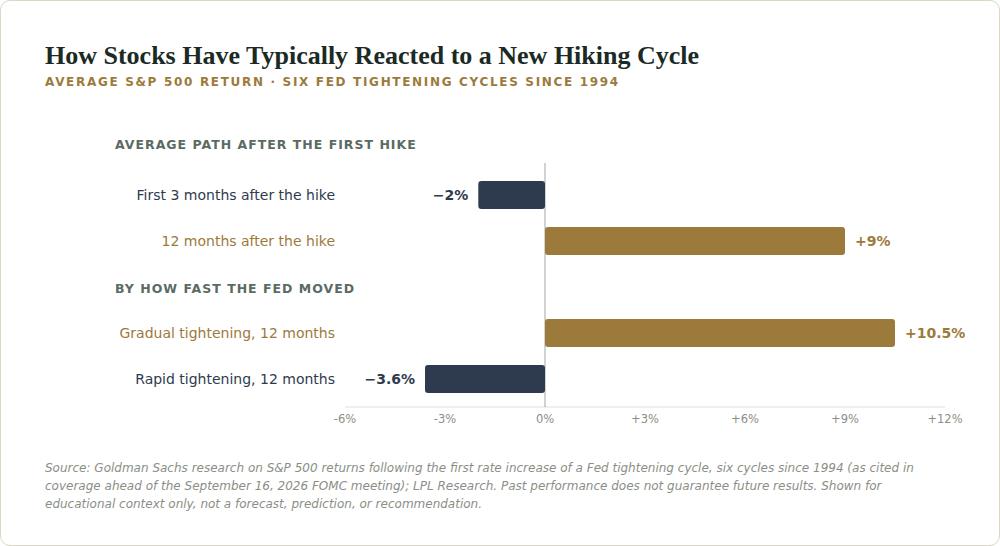
History offers a useful, if imperfect, guide here. Looking at the six Fed tightening cycles since 1994, the S&P 500 has tended to dip in the first few months after the initial hike, then recover and move higher over the following year, though how gradually the Fed moves has made a real difference to the outcome.
None of this means a rate decision should drive a change to your equity allocation on its own. It means the reasons stocks move on Fed days are usually mechanical and short-term, which is exactly why a portfolio built around your actual goals and time horizon shouldn’t be re-engineered around a single announcement.

A note from Robert
Founder, Reese Legacy Capital
I’ve sat with enough clients through enough Fed decisions to know the instinct on announcement day is to want to do something. Usually the right move is the one you already made when we built your plan: the ladder, the allocation, the cash reserve, all sized for moments exactly like this one. If a decision genuinely changes something for your situation, we’ll tell you. If it doesn’t, we’d rather you hear that from us than guess on your own.
How Reese Legacy Capital thinks about Fed decisions for clients
We don’t trade a portfolio around FOMC announcements, and we’re skeptical of anyone who says they can do so reliably. What we do instead is make sure the plan was built to withstand rate moves in either direction before the meeting ever happens:
- Bond and CD ladders structured so maturities are spread across time, reducing the odds you’re forced to reinvest a large chunk of fixed income at a single, potentially unfavorable rate.
- Cash reserves sized to your actual spending needs, reviewed periodically so idle money isn’t quietly losing ground to a better available yield.
- An equity allocation matched to your time horizon and goals, not to short-term rate speculation, so a single announcement doesn’t call the whole plan into question.
Frequently asked questions
Does a Fed rate increase mean I should sell my bonds?
Not automatically. If you hold a bond to maturity, a price dip from rising rates doesn’t change what you’ll ultimately receive. Selling early to avoid a temporary price decline can lock in a loss you didn’t need to take. The better question is whether your bond ladder’s timing still matches your needs.
Should I move money out of stocks before a Fed decision?
Trying to time an announcement is difficult even for professional traders, and markets frequently price in expected moves well before they happen. A long-term allocation built around your goals is generally a sturdier approach than a short-term reaction to a single meeting.
Is now a good time to lock in a CD rate?
It depends on where you think rates are headed and how soon you’ll need the money; there’s no universal answer. This is exactly the kind of decision worth walking through with an advisor who knows your full financial picture rather than a general rule of thumb.
How often should I check on my portfolio after a Fed meeting?
Reacting to every meeting individually tends to create more noise than insight. We review client portfolios on a regular schedule and reach out directly if a decision meaningfully affects your specific plan.
This article is for educational purposes only and does not constitute legal, tax, or investment advice. Reese Legacy Capital is a registered investment adviser; registration does not imply a certain level of skill or training. Please consult your own financial, tax, or legal professional before making decisions based on this content.
Not sure what this Fed decision means for your plan?
Let’s walk through it together, no pressure, just clarity.
Or call directly: 717-327-9582