

“Fiduciary” gets used loosely in financial services, sometimes as a genuine legal standard, sometimes as a marketing word attached to someone who doesn’t actually carry that obligation. The difference is not a technicality. It determines whether the person advising you is legally required to put your interests ahead of their own, or only required to avoid recommending something clearly unsuitable. This page covers what the word actually means, how to verify it for yourself in under five minutes, and how an independent, fee-only RIA in Lancaster differs from the brokerage and bank advisors most people default to.
Fiduciary vs. Suitability (Reg BI), in Plain English
A fiduciary, typically an investment adviser representative of a Registered Investment Adviser (RIA), is legally obligated to act in your best interest at all times and to put your interests ahead of their own. That duty applies continuously, not just at the moment of a specific recommendation.
A broker-dealer representative operates under a different standard called Regulation Best Interest, or Reg BI. It requires that a specific recommendation be in your best interest when it is made, but it does not carry the same ongoing, all-the-time obligation a fiduciary has. In practice, the gap shows up around compensation: a broker can recommend a product that pays them more, as long as it clears the Reg BI bar, while a fiduciary has an ongoing duty to put your interests first, including around how they get paid.
Neither label guarantees good advice on its own, competence and fit still matter, but knowing which standard applies to the person across the table changes what you should ask them, and what you should expect from the relationship.
Independent RIA vs. Wirehouse vs. Bank Advisor
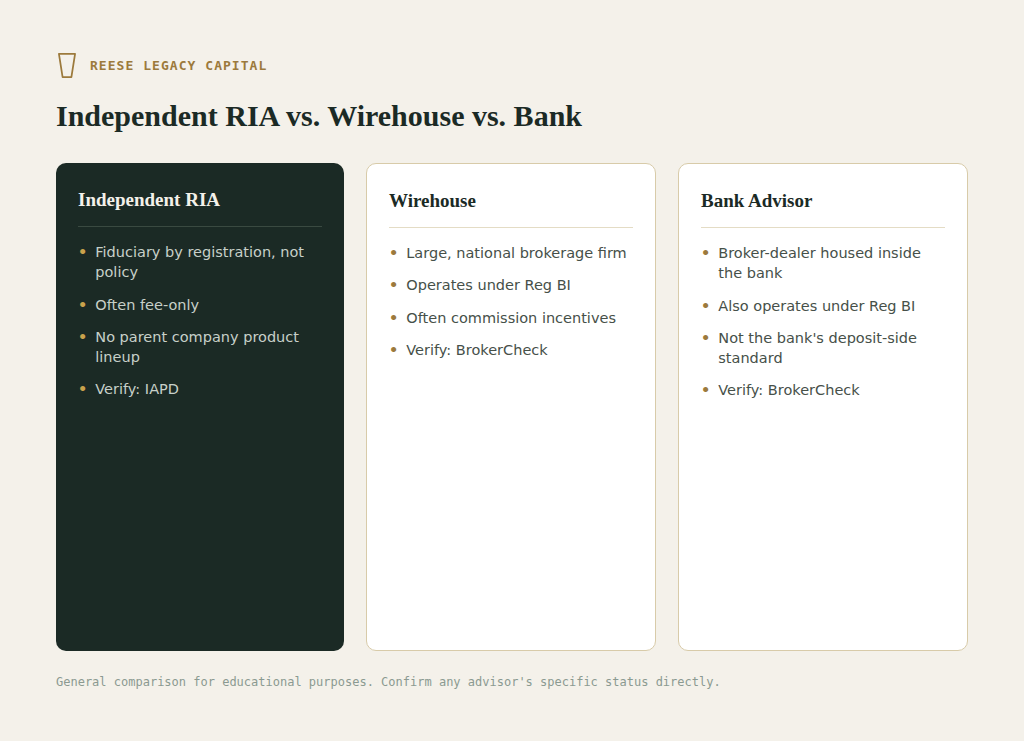
The type of firm someone works for is a strong signal of which standard applies and how they get paid:
Independent RIA. A Registered Investment Adviser, registered with the SEC or, for smaller local firms, with the state, here that means the Pennsylvania Department of Banking and Securities. An independent RIA is held to the fiduciary standard as a matter of registration, not company policy, and is typically not owned by, or beholden to, a larger parent company’s product lineup.
Wirehouse. The industry term for the large, national full-service brokerage firms, the kind with a household name and a branch in most cities. Advisors there are generally registered representatives of a broker-dealer, operating under Reg BI rather than a continuous fiduciary duty, and often compensated in part through commissions or proprietary product incentives tied to the parent company.
Bank advisor. Usually an employee of a broker-dealer that operates inside the bank rather than an employee of the bank’s deposit and lending side. The advisor is generally subject to the same Reg BI standard as a wirehouse representative, not the bank’s separate reputation for stability or safety.
Dual-registered. Some professionals are dual-registered: an IAR of an RIA and a broker-dealer representative. The standard that applies can depend on the hat they’re wearing for that account. Ask which registration covers the relationship you’re considering. This setup is common enough in Lancaster that it is worth asking about directly rather than assuming someone falls neatly into just one of the categories above.
None of this means every wirehouse or bank advisor gives bad advice, or that every RIA is a perfect fit for you. It means the legal and financial incentives are structured differently before either of you says a word, and it is worth knowing which structure you are walking into.
Fee-Only, and Why It’s Different From “Fee-Based”
A fee-only advisor is paid directly by the client, a percentage of assets managed, a flat fee, or an hourly rate, and accepts no commissions from product sales. This removes the incentive to recommend a product because it pays better than the alternative. “Fee-based” sounds similar but describes a blended structure that still allows commissions alongside fees, a meaningfully different incentive picture despite the similar name. If you are specifically looking for a fee-only advisor in Lancaster, it is worth asking the question directly rather than assuming the label applies just because “fee” is in the name somewhere.
How to Verify It Yourself, Directly
You do not have to take anyone’s word for their fiduciary status, including mine. It is a five-minute, free lookup.
For a Registered Investment Adviser, search their Form ADV on the SEC’s Investment Adviser Public Disclosure (IAPD) database. Part 1 shows business details and disciplinary history. Part 2, often called the brochure, explains services, fees, and conflicts of interest in plain language, and every prospective client is entitled to receive a copy before signing anything.
For a broker-dealer representative, check FINRA BrokerCheck, which shows licensing history, employment history, and any customer complaints or regulatory actions on record.
You can also just ask directly: “Are you a fiduciary at all times, for every account and product we’d discuss?” A straight answer, in writing if you ask for it, tells you a lot on its own.
Does Fiduciary Mean Cheaper?
Not necessarily, and it is worth being direct about that instead of overselling the word. A fiduciary standard changes whose interest the advice is supposed to serve; it does not set a price ceiling. What it does tend to do is remove the incentive to steer you toward a more expensive product simply because it pays the advisor more, which is a different, narrower thing than “cheap.” An independent RIA’s fee may be higher or lower than a given brokerage’s costs depending on the specific accounts and products being compared, so this is worth asking about directly rather than assuming the fiduciary label settles the cost question by itself.
How Reese Legacy Capital Fits
Reese Legacy Capital is an independent, fee-only Registered Investment Adviser based in East Petersburg, serving families throughout Lancaster County, including Lititz and Manheim Township, directly. As a fiduciary, I am legally obligated to act in your best interest, I manage each portfolio individually rather than sorting clients into a shared model, and you work directly with the person managing your money, not a rotating service team or a call center. If you want to see whether that fits your situation, or just want a second opinion on an advisor you’re already talking to, start a conversation. For a broader walkthrough of what to look for beyond the fiduciary question, How to Choose a Financial Advisor in Lancaster, PA covers credentials, fee structures, and red flags in more depth. And if you’re thinking further ahead than a single advisor relationship, toward how a plan actually holds together across investments, estate planning, and family goals, Legacy Building is where that fits into how I work.
Frequently Asked Questions
Is every financial advisor a fiduciary?
No. “Financial advisor” is not itself a regulated title, and plenty of people who use it operate under Regulation Best Interest rather than a continuous fiduciary duty. Whether someone is a fiduciary depends on their registration, generally as an investment adviser representative of an RIA, not on their job title or how they describe themselves.
How do I check if my advisor is actually a fiduciary?
Look them up directly. Use IAPD if they present themselves as an investment adviser representative, or FINRA BrokerCheck if they’re a broker-dealer representative. You can also ask them directly and request it in writing; a fiduciary should be able to state that plainly without hedging.
Does fiduciary mean cheaper?
Not automatically. It changes whose interest a recommendation is supposed to serve, not the price of the advice itself. It does tend to remove the incentive to push a costlier product purely because it pays the advisor more, but comparing actual fees is still a separate, worthwhile step.
This article is for general educational purposes and is not legal, tax, or investment advice. Investment advisory services are offered by Reese Legacy Capital, LLC only in states where it is properly registered or excluded or exempted from registration requirements.