
Search “financial advisor near me” in Lancaster County and you will get banks, big national brokerage branches, insurance agents who also sell investments, and independent firms, all using the same title. “Financial advisor” is not a licensed, regulated term. Almost anyone who sells a financial product can use it. That does not mean the choice does not matter. It means the title alone tells you almost nothing, and the real differences are underneath it.
This guide covers what actually separates one advisor from another: the legal standard they answer to, how they get paid, what their credentials mean, and how to check their background before you ever sit down with them. It is written for someone comparing options in Lancaster, not for a national audience, though the underlying rules apply everywhere in the U.S.
The Single Most Important Question: Fiduciary or Not?
Every advisor you talk to falls into one of two legal categories, and the difference is not academic.
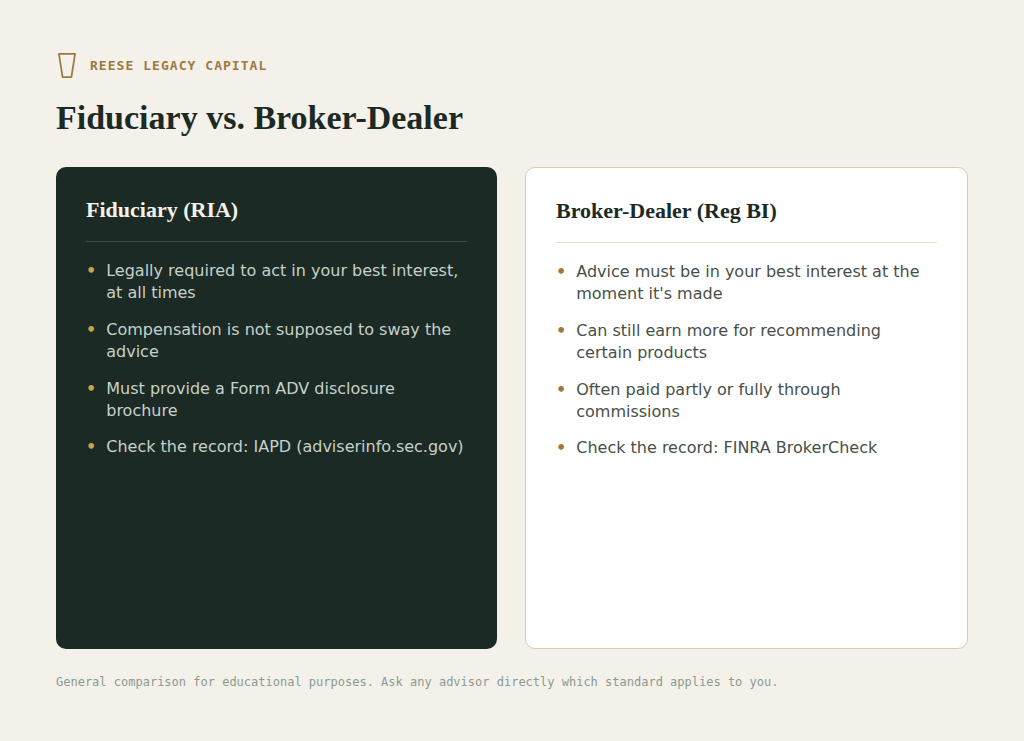
A fiduciary, typically an investment adviser representative of a Registered Investment Adviser (RIA), is legally obligated to act in your best interest at all times, and to put your interests ahead of their own. A broker-dealer representative, by contrast, operates under Regulation Best Interest (Reg BI), a standard that requires a recommendation be in your best interest at the moment it is made, but does not carry the same ongoing, all-the-time obligation a fiduciary has. In practice, that gap matters most around cost: a broker can recommend a product that pays them more, as long as it clears the Reg BI bar, while a fiduciary is not supposed to let compensation influence the recommendation at all.
Neither standard is a guarantee of good advice by itself. But it is worth knowing which one applies to the person across the table, and it is a fair, direct question to ask: “Are you a fiduciary at all times, or only sometimes?”
What Kind of Advisor Are You Actually Talking To?
A few common setups show up repeatedly in Lancaster and the surrounding area, and they are not interchangeable:
Independent Registered Investment Advisers. Firms and individuals registered as RIAs with the SEC or, more commonly for smaller local firms, with the state, here that means the Pennsylvania Department of Banking and Securities. RIAs are held to the fiduciary standard described above.
Broker-dealer representatives. Often employed by large national firms or bank-affiliated brokerages, operating under Reg BI, and frequently paid in part through commissions on the products they sell.
Insurance agents and “dual-registered” advisors. Some professionals hold both an insurance license and a securities registration, meaning the standard that applies can shift depending on which product they are discussing with you at that moment.
Bank and credit union advisors. Usually affiliated with a broker-dealer that operates inside the bank, subject to the same Reg BI standard as other brokerage representatives, not the bank’s own reputation for safety.
How They’re Paid, and Why It Shapes the Advice
Compensation structure is one of the clearest windows into an advisor’s incentives.
Fee-only. The advisor is paid directly by you, typically a percentage of assets managed, a flat fee, or an hourly rate, and accepts no commissions from product sales. This structure removes the incentive to recommend a product because it pays better.
Fee-based. A blend: some fee income, plus the ability to also earn commissions on certain products. The name sounds similar to fee-only, but the incentive structure is meaningfully different, and worth asking about directly.
Commission-based. The advisor is paid by the companies whose products they sell, such as mutual funds, annuities, or insurance policies. This is the most common structure among traditional brokers and insurance-licensed agents.
None of these structures makes someone dishonest. But asking “How are you paid, on this specific recommendation?” is one of the most useful questions you can ask in a first meeting, and any advisor worth working with should answer it plainly.
Credentials That Actually Mean Something
Financial services has more designations than most people can keep track of, and some carry real weight while others require little more than a fee and a weekend course. A few worth knowing:
CFP® (Certified Financial Planner). Requires coursework, a comprehensive exam, relevant experience, and ongoing fiduciary and ethics obligations tied to the certification itself, not just an employer’s policy.
CFA (Chartered Financial Analyst). A rigorous, investment-analysis-focused credential more common among portfolio managers and analysts than retail-facing advisors, though some advisors hold it as well.
RIA / IAR. Not a credential exactly, but a registration status, an Investment Adviser Representative of a Registered Investment Adviser, that carries the fiduciary duty discussed above.
A credential is a reasonable signal, not a substitute for checking someone’s actual record, which is the next step.
Check Their Background Before You Meet
This step takes about five minutes and it is free. Every investment adviser and broker in the country has a public record.
For a Registered Investment Adviser, look up their Form ADV on the SEC’s Investment Adviser Public Disclosure (IAPD) database. Part 1 covers business and disciplinary history; Part 2, often called the “brochure,” explains their services, fees, and any conflicts of interest in plain language, and every prospective client is entitled to receive it.
For a broker-dealer representative, check FINRA BrokerCheck, which shows licensing, employment history, and any customer complaints or regulatory actions.
Also ask for, or look up, their Form CRS (Client Relationship Summary), a short, standardized document every advisor and broker is required to provide that spells out services, fees, and the specific legal standard that applies to your relationship with them.
Why Local Can Matter
None of the above depends on geography. But there are practical reasons a Lancaster-based advisor is worth weighing against a call-center voice at a national firm. A local, independent advisor is more likely to be the actual person managing your account, not a rotating service team you are reassigned to every few years as you cross asset thresholds. They are reachable in person, familiar with the local cost of living and the kinds of assets common in this area (family businesses, farmland, multi-generational real estate), and their reputation is tied to the same community you live in, which is its own kind of accountability.
That is not an argument against every large firm, some are excellent. It is a reason to at least put a local, independent option in the comparison rather than defaulting to whichever name is most familiar.
Questions Worth Asking in a First Conversation
A short list to bring with you, in your own words if that is more natural:
- Are you a fiduciary at all times, for all the accounts and products we would discuss?
- How exactly are you paid, on this account and on any products you might recommend?
- Do you manage portfolios individually, or place clients into a shared model?
- Will I be working directly with you, or handed off to a team as my account grows?
- What is your typical client’s situation, and does mine actually fit that?
- What happens if I want to leave? Are there fees or restrictions tied to transferring out?
Red Flags Worth Slowing Down For
A few patterns are worth pausing on rather than a reason to walk out immediately, since context matters: pressure to decide quickly or sign paperwork in the first meeting; vague or evasive answers about compensation; a product-first conversation before anyone has asked about your actual goals; guaranteed returns of any kind, which no legitimate advisor promises; and an unwillingness to put their fiduciary status, or lack of one, in writing.
How Reese Legacy Capital Fits Into This
We are an independent Registered Investment Adviser based in East Petersburg, serving Lancaster County directly. As a fiduciary, we are legally obligated to act in your best interest, we manage each portfolio individually rather than sorting clients into a shared model, and you work directly with the person managing your money, not a rotating service team. If you are comparing options and want to see whether a direct, local relationship makes sense for your situation, start a conversation.
If you are earlier in the process and want to understand what ongoing portfolio management actually includes before you start comparing advisors, our guide on what a portfolio management service actually includes is a useful next read.
Frequently Asked Questions
What’s the difference between a financial advisor and a financial planner?
Neither term is legally defined on its own. In practice, “financial planner” often implies a broader focus on your full financial picture, budgeting, retirement, taxes, and estate considerations, while “financial advisor” is sometimes used more narrowly for investment management. The titles overlap heavily in real use, so the designations and standards discussed above matter more than which word someone uses to describe themselves.
How much does a financial advisor cost in Lancaster, PA?
It depends heavily on the fee structure and the firm. Fee-only advisors managing a portfolio commonly charge in the range of roughly 0.5% to 1.5% of assets managed annually, often on a sliding scale, while commission-based arrangements can cost more or less depending on the specific products involved and are harder to compare directly. Ask any advisor for their fee schedule in writing before you commit.
Do I need a certain amount of money to work with a financial advisor?
Minimums vary widely. Large national firms often set formal minimums that can run into six or seven figures. Many independent, local RIAs set lower minimums or none at all, and make that decision based on a conversation about your actual situation rather than a fixed cutoff. It is always worth asking directly rather than assuming you do not qualify.
Is a fiduciary always better than a non-fiduciary advisor?
The fiduciary standard is a meaningfully higher legal bar, and it is reasonable to prefer it. But the standard alone does not guarantee a good fit. Two fiduciaries can differ in experience, communication style, and whether their typical client resembles you. Use the fiduciary question to narrow the field, then evaluate the person the same way you would evaluate any professional relationship.
How do I know if my current advisor is actually a fiduciary?
Ask directly, and ask for it in writing. You can also check their registration and standing yourself through IAPD if they are an investment adviser representative, or BrokerCheck if they are a broker-dealer representative. Their Form CRS will also state the legal standard that applies to your relationship.
This article is for general educational purposes and is not legal, tax, or investment advice. Fee ranges cited are general and not a quote for any specific engagement. Investment advisory services are offered by Reese Legacy Capital, LLC only in states where it is properly registered or excluded or exempted from registration requirements.