
A portfolio management service is an ongoing arrangement where a professional advisor builds, monitors, and adjusts an investment portfolio on your behalf, based on your goals, time horizon, and risk tolerance, rather than leaving you to research and manage those decisions on your own. It is a relationship, not a one-time transaction: the manager keeps working after the initial portfolio is built, rebalancing it, adjusting it as your life changes, and staying in touch with you along the way.
That is the short answer. The rest of this guide covers what the service actually includes, how it differs from other ways people invest, how managers get paid, and how to think about whether it is worth it for you.
What’s Actually Included
Under the umbrella of “portfolio management,” a few things typically happen on an ongoing basis:
- Building the portfolio. Selecting a mix of stocks, bonds, funds, and other assets based on your goals and risk tolerance, not a generic template.
- Monitoring and rebalancing. Markets move, and a portfolio that started at the right mix of investments drifts over time. A manager rebalances it back to target.
- Adjusting for life changes. A new job, a sale of a business, an inheritance, retirement, these events change what your portfolio should be doing, and a manager updates the strategy accordingly.
- Tax awareness. Thoughtful timing of trades, use of tax-advantaged accounts, and coordination with your CPA where relevant.
- Reporting and communication. Regular statements and check-ins, so you know what you own and why.
Discretionary vs. Non-Discretionary Management
Most portfolio management services are discretionary, meaning the manager can execute trades and make adjustments without calling you for approval on every transaction. That authority is a two-way street: it only works because the manager is a fiduciary, legally obligated to act in your best interest rather than their own, and because you set the boundaries of that authority up front, including your goals, restrictions, and risk tolerance. Non-discretionary arrangements exist too, where the advisor recommends trades but you approve each one, though this is less common for ongoing portfolio management specifically.
How It’s Different From a Robo-Advisor
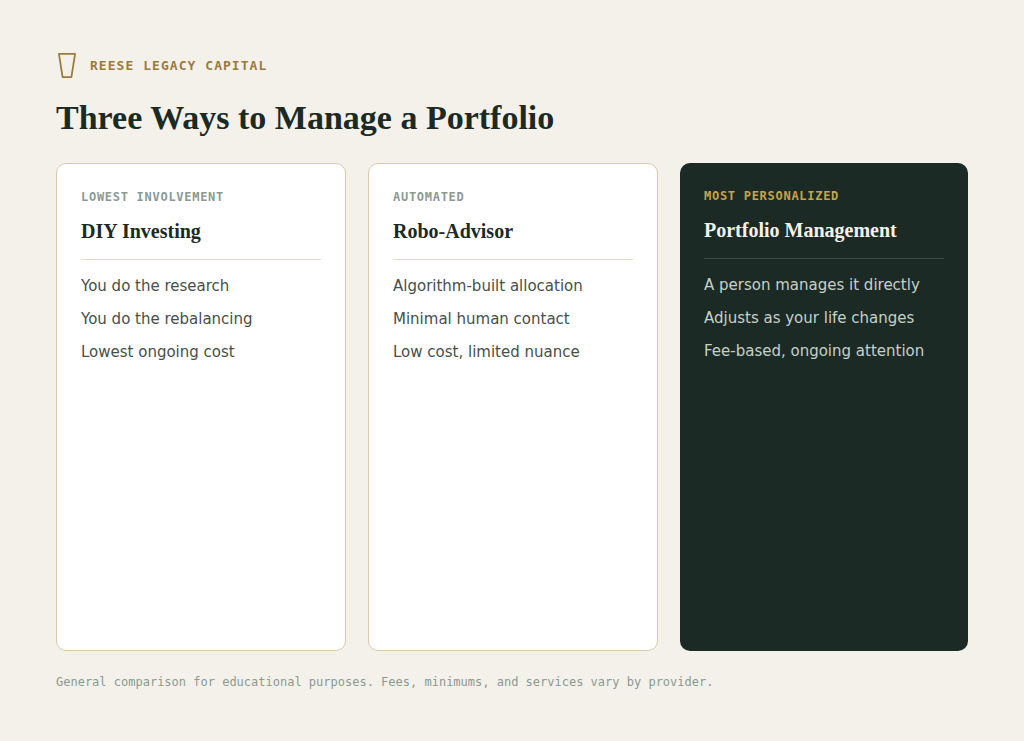
A robo-advisor manages a portfolio using an algorithm, typically sorting you into one of several model allocations based on a short questionnaire, with minimal human involvement. It is inexpensive and reasonable for a straightforward, smaller account. A portfolio management service, by contrast, involves an actual person who understands your full financial picture, not just your answers to ten questions, and who can adjust for things an algorithm was never built to consider: a concentrated stock position from an employer, a pending liquidity event, a trust with specific distribution terms, or a tax situation that needs coordination with your other advisors.
How It’s Different From Buying Funds on Your Own
Buying a handful of mutual funds or ETFs yourself is a reasonable starting point for many people, and there is no rule that says you need a manager. What a portfolio management service adds is ongoing attention: someone who rebalances when you do not get around to it, adjusts the strategy as your circumstances change, and is accountable for the full picture rather than one account in isolation. The tradeoff is straightforward too. You pay a fee for that ongoing attention, so it is worth being honest with yourself about whether you have the time, interest, and discipline to manage it well on your own, or would rather hand that ongoing work to someone whose job it is.
How Portfolio Managers Are Paid
Most portfolio management services charge a fee based on a percentage of assets under management, billed quarterly or annually. This fee structure is worth understanding because it shapes incentives: a manager paid this way generally benefits when your portfolio grows, not from trading frequency or product sales. That said, fee structures vary by firm, and some advisors also earn commissions on specific products they recommend, which can create a conflict of interest. It is a fair question to ask any advisor directly: how are you paid, and are you a fiduciary at all times, not only when it is convenient? You can also look up any advisor’s background directly through the SEC before you sign anything.
Who a Portfolio Management Service Is Right For
This kind of service tends to make the most sense for people who are past the very early, small-account stage of investing and who are dealing with real complexity or real stakes: a business sale, an inheritance, an executive comp package with vesting stock, a retirement transition, or simply enough assets that the cost of getting it wrong outweighs the cost of the fee. It also tends to appeal to people who would rather spend their time on their career, their family, or their own business than on researching investments, without giving up the ability to ask questions and understand what is happening with their money.
What Makes One Provider Different From Another
Not every portfolio management service looks the same. Some large firms sort clients into one of a handful of model portfolios and hand off day-to-day service to a rotating team. Others, particularly smaller, independent, fiduciary firms, manage each portfolio individually and give clients direct access to the person actually making the decisions. Neither approach is automatically right or wrong, but it is worth knowing which one you are getting before you sign on, since the difference shows up later in how quickly you can get someone on the phone and how personalized the strategy actually is.
Frequently Asked Questions
Is a portfolio management service the same as a financial advisor?
They overlap but are not identical. “Financial advisor” is a broad term that can include retirement planning, insurance, tax strategy, and more. Portfolio management specifically refers to the ongoing management of your investment portfolio, though many advisors, including fiduciary RIAs, provide both as part of a single relationship.
What’s the minimum to use a portfolio management service?
Minimums vary widely by firm, from no minimum at smaller, independent practices to seven figures at some larger institutions. It is worth asking directly rather than assuming you do not qualify.
Is portfolio management worth the fee?
It depends on what you value: your own time, the complexity of your situation, and how confident you are managing investments without help. For a straightforward, small account, it may not be. For someone navigating a major transition or a growing, complex set of assets, the ongoing attention and accountability is often the point, not the return alone.
How Reese Legacy Capital Approaches Portfolio Management
We manage each portfolio directly, for the actual person, family, or trust it belongs to, rather than sorting clients into a shared model. As a Registered Investment Adviser, we act as a fiduciary. If you want to talk through what that looks like for your situation, start a conversation.
This article is for general educational purposes and is not investment, legal, or tax advice. Investment advisory services are offered by Reese Legacy Capital, LLC only in states where it is properly registered or excluded or exempted from registration requirements. Past information is general in nature and not a guarantee of future results.