

If you have talked to an attorney or a financial advisor about your estate plan, you have probably heard the word “trust” more than once. What often gets left out of that conversation is why a trust actually helps, in plain terms, and which of its advantages apply to your specific situation. This guide walks through the real advantages of a trust: what they are, when they apply, and where a trust stops being useful and a will or another tool takes over.
This article is educational and does not replace advice from a qualified estate planning attorney or tax professional, who can speak to the laws in your state and your specific circumstances.
What a Trust Actually Is, Briefly
A trust is a legal arrangement where you (the grantor) transfer ownership of assets to a trustee, who manages those assets for the benefit of the people you name (your beneficiaries), according to instructions you write into the trust document. You can serve as your own trustee while you are living and able to do so, with a successor trustee ready to step in later.
Most of a trust’s advantages come down to one idea: assets titled in a trust are governed by the trust document, not by the public, court-supervised process that applies to assets passed through a will.
Revocable vs. Irrevocable: Why the Distinction Matters
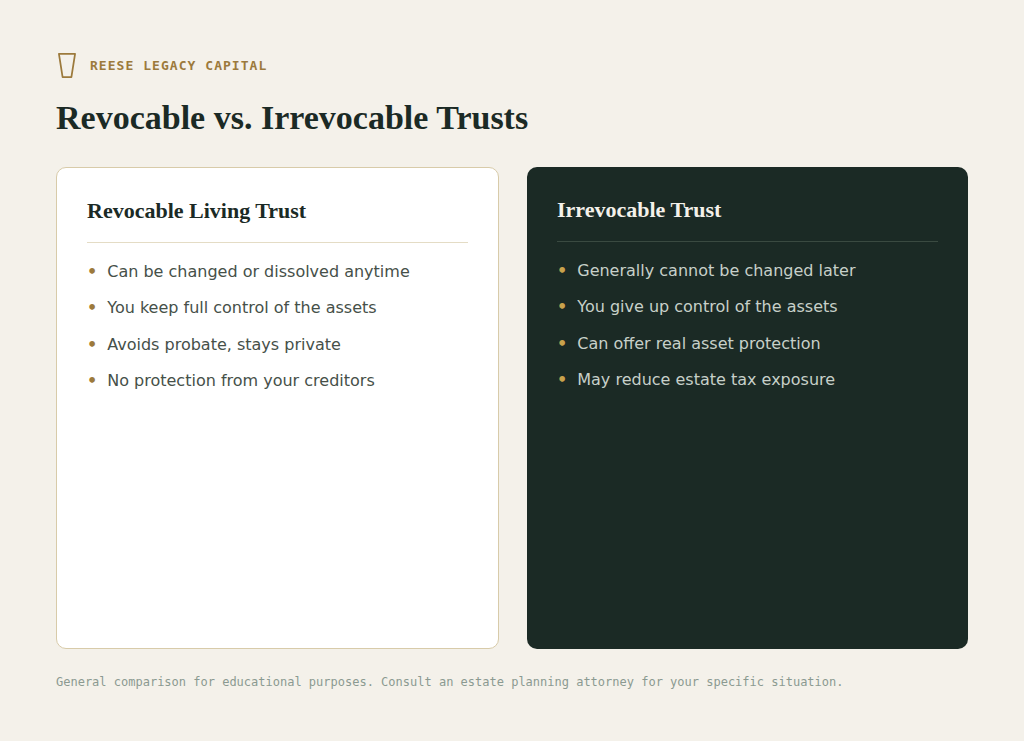
Before getting into specific advantages, it helps to know that not every trust offers every benefit on this list. The most common type, a revocable living trust, can be changed or dissolved by you at any time while you are alive and mentally competent. It offers convenience, privacy, and incapacity planning, but because you still control the assets, it does not shield them from your own creditors.
An irrevocable trust gives up that flexibility. Once assets are transferred in, you generally cannot change your mind or reclaim them. In exchange, an irrevocable trust can offer real asset protection and, depending on how it is structured, estate tax benefits that a revocable trust cannot. Which one fits your situation is a decision to make with your attorney, not a one-size-fits-all answer.
1. Avoiding Probate
Probate is the court process that validates a will, settles debts, and distributes assets after someone passes away. It is public, it can take months to over a year depending on the state and the complexity of the estate, and it typically comes with court and legal fees. Assets held in a properly funded trust bypass probate entirely. The successor trustee simply steps in and distributes assets according to the trust’s terms, without court involvement.
2. Privacy
A will becomes a public record once it is filed with the probate court. Anyone can request a copy and see what you owned, who received it, and how much. A trust is a private document. Its terms, and the identities of your beneficiaries, generally stay out of the public record. For families who would rather not broadcast their financial affairs, this is one of the more underrated advantages of a trust.
3. Control Over How and When Assets Are Distributed
A will typically hands assets over outright. A trust lets you set the terms. You can stagger distributions by age or milestone, direct funds toward specific purposes like education, or protect a beneficiary who is not ready to manage a lump sum. This matters most for young beneficiaries, blended families, or anyone with a beneficiary who has creditor, spending, or relationship concerns you want to plan around.
4. Planning for Incapacity
Estate planning is not only about what happens after death. If you become unable to manage your own affairs, a revocable trust already has a successor trustee named and ready to step in immediately, managing assets on your behalf without a court-supervised guardianship or conservatorship proceeding. Those proceedings are public, often slow, and can be expensive. A properly funded trust sidesteps that process entirely.
5. Simplifying Assets Held in Multiple States
If you own real estate or other property in more than one state, your estate could otherwise face a separate probate process, called ancillary probate, in each state where property is titled in your name alone. Placing that property in a trust consolidates administration under a single set of instructions, regardless of where the assets are located.
6. Providing for Blended Families and Complex Situations
A trust can direct income to a current spouse during their lifetime while preserving principal for children from a prior marriage, something a straightforward will struggles to do cleanly. The same flexibility helps with a family member with special needs, a beneficiary with a disability who receives government benefits, or any situation where “leave it to them outright” is not the right answer.
7. Potential Asset Protection
This advantage deserves the caveat from earlier: it applies to irrevocable trusts, not revocable ones. Because you no longer own or control assets in a properly structured irrevocable trust, those assets can, depending on the type of trust and your state’s laws, be shielded from your creditors and from certain claims. This is a highly technical area, and the details determine whether protection actually holds up, so it is not a do-it-yourself decision.
8. Coordinating With Your Broader Estate and Tax Plan
For larger estates, certain irrevocable trusts can help manage exposure to federal or state estate taxes by moving assets, and their future growth, outside your taxable estate. Exemption thresholds change over time and vary by state, so this is a conversation to have directly with your estate planning attorney and tax advisor rather than a number worth quoting here. What matters is that a trust can be one piece of a coordinated plan between your legal, tax, and investment strategies, working alongside the attorneys and CPAs already involved in your planning, rather than a document that sits disconnected from the rest of your finances.
A Trust Is Not a One-Size-Fits-All Decision
None of this means everyone needs a trust, or that every trust is the right type for every goal. Trusts involve upfront legal costs, and a trust only works if it is properly funded, meaning your assets are actually retitled into it, a step people sometimes skip. For a simpler estate, a well-drafted will and the right beneficiary designations may accomplish what you need without the added complexity. The right answer depends on your assets, your family situation, and your goals, which is exactly the kind of question worth discussing with an attorney before deciding.
How a Trust Fits Into Your Overall Wealth Plan
A trust is a legal structure. What goes inside it, and how those assets are managed over time, is a separate and ongoing decision. Our trust services at Reese Legacy Capital are not about drafting the trust document, that is your attorney’s work, but making sure the assets inside it are managed in a way that reflects your actual goals and the terms your attorney has written, not handed off to a generic model portfolio disconnected from your estate plan.
If you are also weighing how those assets should be managed day to day, our companion guide on what a portfolio management service actually includes is a good next read. Or, if you would rather talk it through directly, start a conversation.
Frequently Asked Questions
Does a trust avoid estate taxes?
A revocable living trust, on its own, does not reduce estate taxes since the assets are still considered yours. Certain irrevocable trusts can help manage estate tax exposure, but the details depend on the type of trust, your state, and current exemption levels. This is a question for your estate planning attorney and tax advisor.
What is the difference between a trust and a will?
A will takes effect only after death and goes through probate, a public court process. A trust can take effect during your lifetime, avoids probate for assets titled in its name, and stays private. Many people use both: a trust for their major assets and a “pour-over” will to catch anything left outside it.
Can I be the trustee of my own trust?
With a revocable living trust, yes. Most people name themselves as the initial trustee, keeping full control of their assets during their lifetime, and name a successor trustee to take over if they become incapacitated or pass away.
How much does it cost to set up a trust?
Costs vary by complexity and by attorney, and depend on your state and the type of trust. A straightforward revocable living trust generally costs more upfront than a basic will, but it can save meaningfully more in probate costs, delays, and court fees later. Your attorney can give you an accurate estimate based on your situation.
This article is for general educational purposes and is not legal, tax, or investment advice. Reese Legacy Capital, LLC does not provide legal or tax advice; consult a qualified attorney and tax professional regarding your specific situation. Investment advisory services are offered by Reese Legacy Capital, LLC only in states where it is properly registered or excluded or exempted from registration requirements.