
Drive almost any back road in Lancaster County and you will pass land that has stayed in the same family for generations, a farm handed down alongside a set of convictions about hard work, faith, and taking care of what you were given. For families here, planning a legacy is rarely just a financial exercise. It is a spiritual one, tied to a sense of stewardship and a desire to pass on more than property.
That is what we mean when we talk about faith-based family legacy planning. It starts with the same building blocks as any estate plan, a will, beneficiary designations, powers of attorney, but it asks a further question: how do we structure things so the land, the business, and the values behind them actually make it to the next generation intact? For families with a working farm, that question has its own name: farm succession planning, and it comes with its own set of practical decisions on top of the usual estate planning ones.
Whether you call it faith-based family legacy planning or Christian family legacy planning, Lancaster PA families are asking the same underlying question. Here is what goes into a plan that actually holds up, the tools involved (a trust among them, but not the only one), and how it applies specifically to families with a farm or family business to protect.
What faith-based family legacy planning means, beyond a will
A will says who gets what after you die. A legacy plan says how, when, and under what terms, and it tries to answer questions a will was never designed to address:
- What happens if a grandchild inherits before they are ready to manage it responsibly?
- How do you treat a child who worked the farm for twenty years fairly, alongside siblings who did not?
- Who steps in if you become unable to manage your own affairs before you pass?
- How do you pass down not just assets, but the reasons behind the decisions you made with them?
Many faith-based and Christian families in Lancaster PA think about this in terms of stewardship rather than ownership: the idea that what you hold, land, a business, savings, was entrusted to you to manage well and pass along, not simply to spend down or divide evenly without thought. A handful of legal and financial tools do the actual work of carrying that intention forward in writing, for decades after you are no longer there to explain it in person.
The tools that make up a legacy plan
A complete plan usually draws on several of these, not just one:
- A trust, which controls not just who receives assets but when and how, and can hold farmland or a business directly.
- Beneficiary designations, on retirement accounts and life insurance, which override what your will says and are worth checking every few years.
- An entity such as an LLC or family limited partnership, often used alongside a trust to hold farmland or a business and simplify how ownership is divided among heirs.
- Lifetime gifting, including newer tools like education accounts, which moves assets to the next generation while you are still there to guide the transition.
- A letter of wishes or ethical will, a non-binding document that sits alongside the legal paperwork and explains the why behind the what, often the piece that matters most to a faith-based family.
The rest of this article focuses on the two tools that come up most for Lancaster County families with a farm or closely held business to protect: the trust, and the entity structures used for farm succession.
Not sure which of these your family actually needs? That is exactly the kind of question worth talking through before any documents get drafted.
The benefits of a trust for Lancaster County families
People sometimes assume a trust is only for the ultra-wealthy. In practice, a trust earns its place in a family’s plan for reasons that have very little to do with the size of the estate:
- Privacy. A will becomes part of the public probate record. A trust generally does not. In a close-knit church community or small town, that privacy matters to a lot of families.
- Avoiding probate. Assets titled in a trust can pass to heirs without going through the Pennsylvania probate court process, which saves time, legal cost, and the delay of waiting months for an estate to settle.
- Control over timing and terms. A trust can stagger distributions by age or milestone, protect a young or financially inexperienced heir from receiving a large sum all at once, and set conditions that reflect what the family actually values.
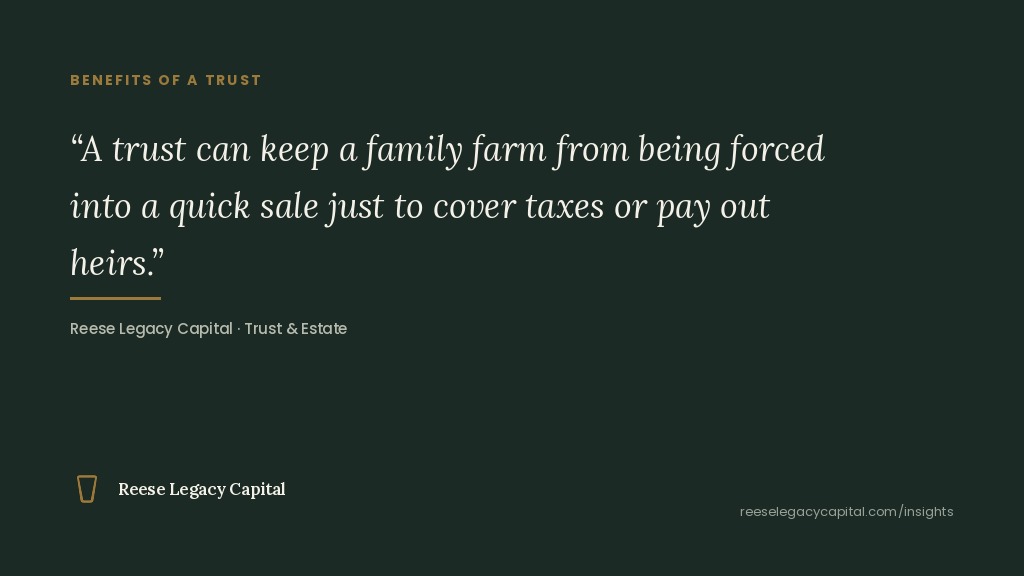
- Protection for a family farm or business. A trust can keep farmland or a closely held business from being forced into a quick sale simply to cover taxes or to pay out heirs who are not involved in running it.
- Fair treatment, not necessarily equal treatment. A trust lets parents provide for a child who farms the land differently than a child who does not, without that decision becoming a source of resentment or a legal dispute after they are gone.
- Continuity if you become incapacitated. A revocable living trust lets a successor trustee step in immediately to manage assets if illness or age makes that necessary, without a court-appointed guardianship.
- Protection for blended families and heirs with special needs. A trust can make sure a surviving spouse is cared for while still preserving what is meant for children from a first marriage, or protect a loved one with special needs without disqualifying them from benefits.
What this means under Pennsylvania law
Pennsylvania is one of a handful of states that still charges an inheritance tax, separate from any federal estate tax. As of 2026, the rates are based on who is inheriting, not the total size of the estate:
- Surviving spouse: 0%
- Children age 21 or younger, inheriting from a parent: 0%
- Lineal heirs, including adult children, grandchildren, and parents: 4.5%
- Siblings: 12%
- All other heirs: 15%
Pennsylvania also offers a meaningful exemption for family farms and family-owned businesses: qualifying agricultural property can pass free of inheritance tax if it stays in agricultural use for seven years after death, with the family certifying that use annually. If the land is sold or taken out of farming within that window, the tax comes due retroactively. This is exactly the kind of detail a trust, paired with clear instructions and the right trustee, can help a family actually follow through on across a generational transition instead of losing the exemption by accident.
It is also worth knowing that federal estate tax is less of a concern for most families than it used to be. As of 2026, the federal estate and gift tax exemption sits at $15 million per person, $30 million for a married couple, and recent legislation made that level permanent rather than temporary. For the vast majority of Lancaster County families, the real risk to a legacy is not the federal estate tax. It is Pennsylvania inheritance tax, probate delays, and disagreements among heirs, all of which a well-built plan is designed to address.
Faith-based farm succession planning in Lancaster, PA
Lancaster County’s identity is tied to its farms, many of them Christian and Plain-community families who have worked the same ground for three, four, or five generations. For these families, succession planning is not just about who inherits the land. It is about who will steward it, how non-farming children are treated fairly, and how the values that shaped the farm get passed down along with the deed.
A few decisions come up in almost every farm succession conversation:
- Who runs the farm next, and how that person builds equity in it over time rather than waiting for an inheritance to take effect.
- How non-farming siblings are treated fairly, often through life insurance, other assets, or a structured buyout, since dividing the farm itself equally can make it impossible to operate.
- What entity holds the land, commonly an LLC or family limited partnership, which can simplify ownership across multiple heirs and make a partial transition easier than an outright deed transfer.
- What values guide the transition, whether that is continued agricultural use, care for aging parents, or a charitable and tithing component built into the plan.
A trust and a farm entity are often used together: the entity holds the land and simplifies ownership, while the trust sets out, in the founder’s own words, how and when control actually passes. Done well, faith-based farm succession planning in Lancaster PA turns a source of potential family conflict into a documented, values-driven plan that the next generation can actually follow, long after the founding generation is no longer there to settle disputes in person.
Farm succession conversations get easier with a second set of eyes. If you are weighing how to treat farming and non-farming heirs fairly, that is worth talking through directly.

A note from Robert Reese
Founder, Reese Legacy Capital
I manage my own family’s trust today, the same way I manage it for the families I work with: hands-on, not handed off. Faith is what keeps me grounded in how I approach this work, and it shapes a lot of the conversations I have with clients about what they actually want their name and their land to stand for after they are gone. If that is the kind of conversation you are trying to have with your own family, I would like to help you have it well.
How Reese Legacy Capital approaches family legacy planning
Reese Legacy Capital is a founder-managed advisory firm based in East Petersburg, PA. There are no model portfolios and no hand-offs to junior associates here. When you work with the firm, you work directly with its founder, Robert Reese.
Reese Legacy Capital is not an estate planning law firm and does not draft trust documents. What the firm does is coordinate directly with your estate planning attorney and CPA so that your investment strategy, your trustee’s decisions, and your tax picture are working together rather than sitting in separate silos. For a family with a farm or a closely held business, that coordination is often the difference between a legacy plan that looks good on paper and one that actually holds up.
Getting started with your family’s legacy plan
A few practical first steps for any Lancaster County family ready to move from good intentions to an actual plan:
- Gather your current estate documents, deeds, and account titling, and note anything that has not been updated in the last several years.
- Have the values conversation with your heirs before the legal documents are drafted, not after. Most family conflict comes from surprise, not from the terms themselves.
- Meet with a Pennsylvania estate planning attorney to draft or update your trust and any entity you need, and involve your CPA on the tax side, especially if farmland or a business is involved.
- Align your investment strategy and beneficiary designations with the plan, so nothing outside the trust accidentally works against it.
Frequently asked questions
What is faith-based family legacy planning?
Faith-based family legacy planning is the process of structuring your will, trust, and financial decisions to reflect your family’s values and sense of stewardship, not just to minimize taxes or divide assets. It typically combines standard estate planning tools with an explicit conversation about how and why assets should pass to the next generation.
What are the benefits of a trust for a family in Pennsylvania?
A trust can help a Pennsylvania family avoid probate, keep estate matters private, control the timing and terms of an inheritance, protect a family farm or business from a forced sale, provide for blended families or heirs with special needs, and allow a successor trustee to manage assets immediately if the founder becomes incapacitated.
Do I need an LLC or a trust for my family farm?
Many farm succession plans use both. An LLC or family limited partnership typically holds the land and simplifies ownership across multiple heirs, while a trust controls when and how control of that entity actually passes to the next generation. A Pennsylvania estate planning attorney can advise on which structure, or combination, fits your specific farm.
Does Pennsylvania tax inherited farmland?
Pennsylvania inheritance tax generally applies based on the heir’s relationship to the deceased, but qualifying family farmland can pass free of inheritance tax if it remains in agricultural use for seven years after death, with annual certification to the Department of Revenue. If the land is sold or taken out of farming within that period, the tax becomes due.
Is Reese Legacy Capital an estate planning attorney?
No. Reese Legacy Capital, LLC is a registered investment adviser, not a law firm. The firm does not draft trusts or wills, but works directly alongside a family’s estate planning attorney and CPA to align investment strategy with the legal and tax plan.
How do I start a family legacy plan in Lancaster County, PA?
Start by gathering your current documents, having an honest conversation with your heirs about your intentions, and meeting with a Pennsylvania estate planning attorney and CPA. From there, an adviser can help make sure your investment strategy and account titling actually support the plan you have put in place.
If you’re in Lancaster County and want to talk through what a family legacy plan should actually look like for your family, I’m glad to have that conversation.
This article is for general educational purposes only and does not constitute legal, tax, or investment advice for any individual family or situation. Pennsylvania inheritance tax rules, federal estate and gift tax exemptions, and agricultural exemption requirements are subject to change and depend on individual facts. Reese Legacy Capital, LLC is a registered investment adviser and does not provide legal or tax advice. Please consult a licensed Pennsylvania estate planning attorney and a qualified CPA regarding your specific circumstances.
Work directly with the founder, no hand-offs, no model portfolios.
Start a conversation
Or call directly: 717-327-9582