

Most people who benefit from a trust — or who name someone as trustee in their own estate plan — have never actually seen a trustee’s job up close. It’s a role people agree to without fully knowing what they’re signing up for, and a role beneficiaries depend on without knowing what they’re entitled to ask about. Here’s what the job actually involves.
What a trustee actually does
A trustee is the person or institution named in a trust document to hold legal title to the trust’s assets and manage them for the benefit of someone else — the beneficiary. The trustee doesn’t own the assets personally, even though their name may be on the account; they’re managing that property under a fiduciary duty, which is a legal standard higher than the one that applies to managing your own money. That distinction is the whole job in one sentence: everything a trustee does has to be judged by what’s best for the beneficiary, not what’s convenient for the trustee.
The core duties every trustee owes
A handful of duties show up in trust law regardless of which state the trust is administered in:
Duty of loyalty. A trustee can’t let personal interests, other clients, or conflicts of interest influence decisions about trust assets. Self-dealing — even well-intentioned self-dealing — is one of the fastest ways a trustee ends up personally liable.
The prudent investor rule. Most states, including Pennsylvania, have adopted a version of the Uniform Prudent Investor Act, which sets the legal standard for how trust assets must be invested — diversified, risk-appropriate for the trust’s purpose and time horizon, and managed with the kind of care a prudent investor would use for their own significant assets. This is a meaningfully higher bar than “don’t lose the money,” and it’s the same standard I hold every trust portfolio to.
Duty to inform and account. Beneficiaries are generally entitled to a real accounting of what’s happening with trust assets — not just a check once a year. That includes preparing the trust’s Form 1041 fiduciary tax return and issuing Schedule K-1s to beneficiaries showing their share of trust income.
No commingling. Trust assets have to stay legally and administratively separate from the trustee’s own property, full stop.
Delegating appropriately. A trustee isn’t expected to personally be an expert in investment management, tax law, and property management all at once — part of the job is knowing when to bring in a qualified professional for each piece, while still remaining accountable for the outcome.
Individual trustee or corporate trustee?
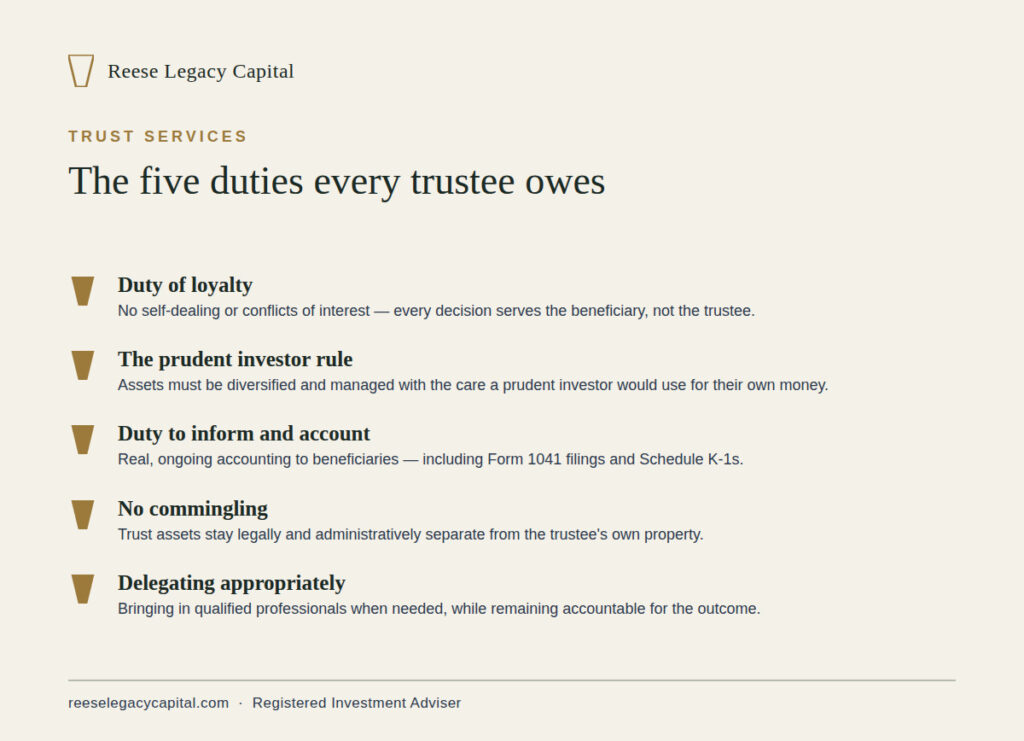
RLC describes the five key duties of a trustee.
This is usually the first real decision a family faces, and there’s a genuine tradeoff either way.
An individual trustee — often a family member or close friend — usually costs less (sometimes nothing) and brings real personal knowledge of the beneficiaries’ actual circumstances. The tradeoff: most individual trustees aren’t equipped with deep investment or trust administration expertise, and naming a family member can create friction or perceived bias, especially among siblings.
A corporate trustee — a bank or trust company — brings professional trust administration, recordkeeping, and investment infrastructure, along with a level of neutrality an individual trustee can’t offer. The tradeoff is usually cost, and a corporate trustee generally won’t have the personal understanding of your family’s actual situation that an individual trustee has.
There isn’t a universally correct answer here — it depends on the size and complexity of the trust, the family dynamics involved, and how much hands-on investment expertise the trust actually needs.
Where investment management fits in
Here’s something worth understanding regardless of which kind of trustee a family chooses: the trustee role and the investment management role don’t have to be the same person or institution. A trustee — individual or corporate — can, and often should, work alongside a dedicated investment manager who handles the portfolio specifically, coordinating with the trustee, the estate attorney, and the family’s CPA rather than trying to be all four at once. That’s a large part of how I work with trust accounts: not replacing the trustee’s role, but handling the piece that actually requires ongoing, hands-on portfolio decisions made under the prudent investor standard — something a part-time individual trustee often can’t do alone, and something a generic model portfolio at a large institution often does without much attention to the specific trust’s purpose.
How a trustee can be removed
Trust documents typically spell out a removal process, and most also name a successor trustee in advance so there’s no gap in administration if a trustee resigns, becomes incapacitated, or passes away. Beyond what the document itself allows, beneficiaries generally have the option to petition a court to remove a trustee for cause — a serious breach of fiduciary duty, mismanagement, or an ongoing conflict of interest are the kinds of issues that typically clear that bar. The exact process varies by state and by the specific language of the trust, so this is genuinely a question for the estate attorney who drafted (or is reviewing) the trust rather than something to assume from general rules.
Frequently asked questions
Can a trustee also be a beneficiary of the same trust? Often, yes — it’s common, for example, for a surviving spouse to be both trustee and a beneficiary. It does raise the stakes on the duty of loyalty, since the trustee has to be especially careful that decisions serve all beneficiaries fairly, not just themselves.
Does a trustee get paid? Individual trustees, especially family members, often serve without compensation, though they’re usually entitled to reasonable compensation if they want it. Corporate trustees charge a fee, typically based on the value of the assets under administration — the exact structure varies by institution and by state law.
What happens if a trustee doesn’t follow the prudent investor rule? A trustee who invests imprudently — overly concentrated positions, inappropriate risk for the trust’s purpose, or simple neglect — can be held personally liable to make the trust whole for losses that resulted from that breach. It’s one of the more common grounds for a beneficiary dispute.
If you’re a trustee trying to figure out how to actually manage a trust’s investments under the prudent investor standard, or a beneficiary trying to understand what you’re entitled to ask for, I’m glad to talk through your specific situation.
This article is for general informational and educational purposes only and does not constitute legal or personalized investment advice. Trust law varies by state; consult a qualified estate attorney for guidance specific to your trust and jurisdiction. Registration as an investment adviser does not imply a certain level of skill or training.