
“How much do you charge?” is usually the second question a prospective client asks, right after “what do you actually do for that fee.” Both deserve a straight answer, in writing, before anyone signs anything. This page is that answer: what a fee-only advisor typically costs, how that compares to industry averages, and exactly what Reese Legacy Capital charges, with real numbers rather than a “contact us for pricing” page.
What “Fee-Only” Actually Means for Your Cost
Fee-only means the advisor is paid directly by you, and only by you: a percentage of the assets they manage, a flat fee, or an hourly rate. No commissions, no product sales, no referral payments from a fund company or insurance carrier changing hands behind the relationship. That matters for cost specifically because it removes the incentive to recommend something because it pays the advisor more, not because it’s better for you.
“Fee-based” is a different, often-confused term. A fee-based advisor can charge a fee and still accept commissions on certain products, which means the incentive fee-only removes is still partly present. If a fee quote seems low, it’s worth asking directly whether commissions are part of the picture anywhere in the relationship. (This distinction is covered in more depth in Fiduciary Financial Advisor in Lancaster, PA.)
The Industry Number, for Context
Before getting into Reese Legacy Capital’s specific fee schedule, it’s worth knowing what “normal” looks like. Industry-wide, the median advisory fee for assets-under-management (AUM) pricing runs close to 0.96% annually, with a typical range of 0.75% to 1.5%, and most advisors charging near 1% for portfolios in the $500,000–$1,000,000 range. Fees generally step down as account size grows. That’s the benchmark to hold any fee quote against, including this one.
Reese Legacy Capital’s Fee Schedule
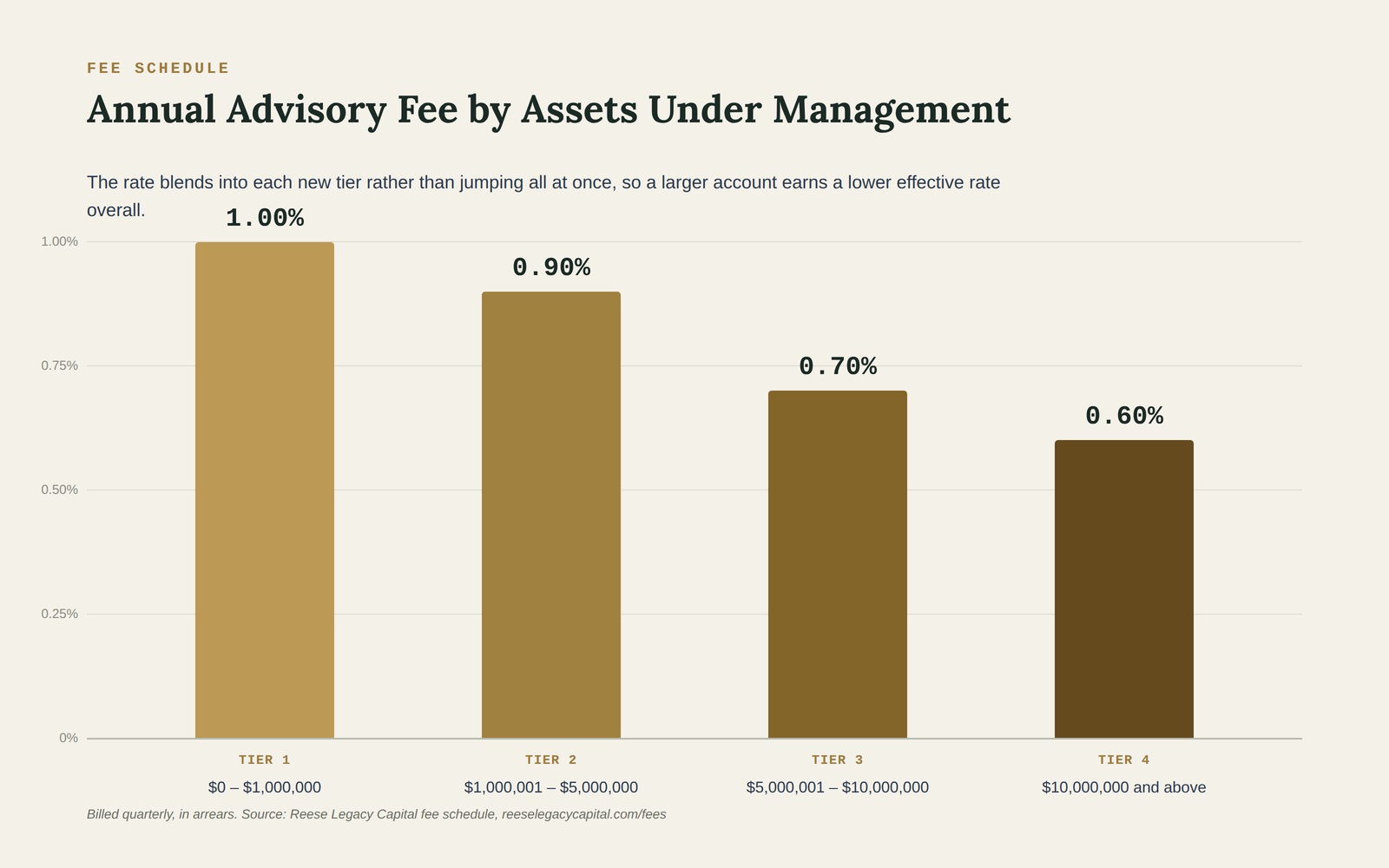
The advisory fee is a percentage of assets under management, billed quarterly, in arrears. As an account grows into a new tier, the rate blends rather than jumping all at once, so a larger relationship is rewarded with a lower effective rate on the whole account, not just the amount above a threshold.
The minimum account size to open or maintain a relationship is $250,000, though this may be reduced or waived case by case, and fees are negotiable depending on the complexity of the relationship.
Two Worked Examples
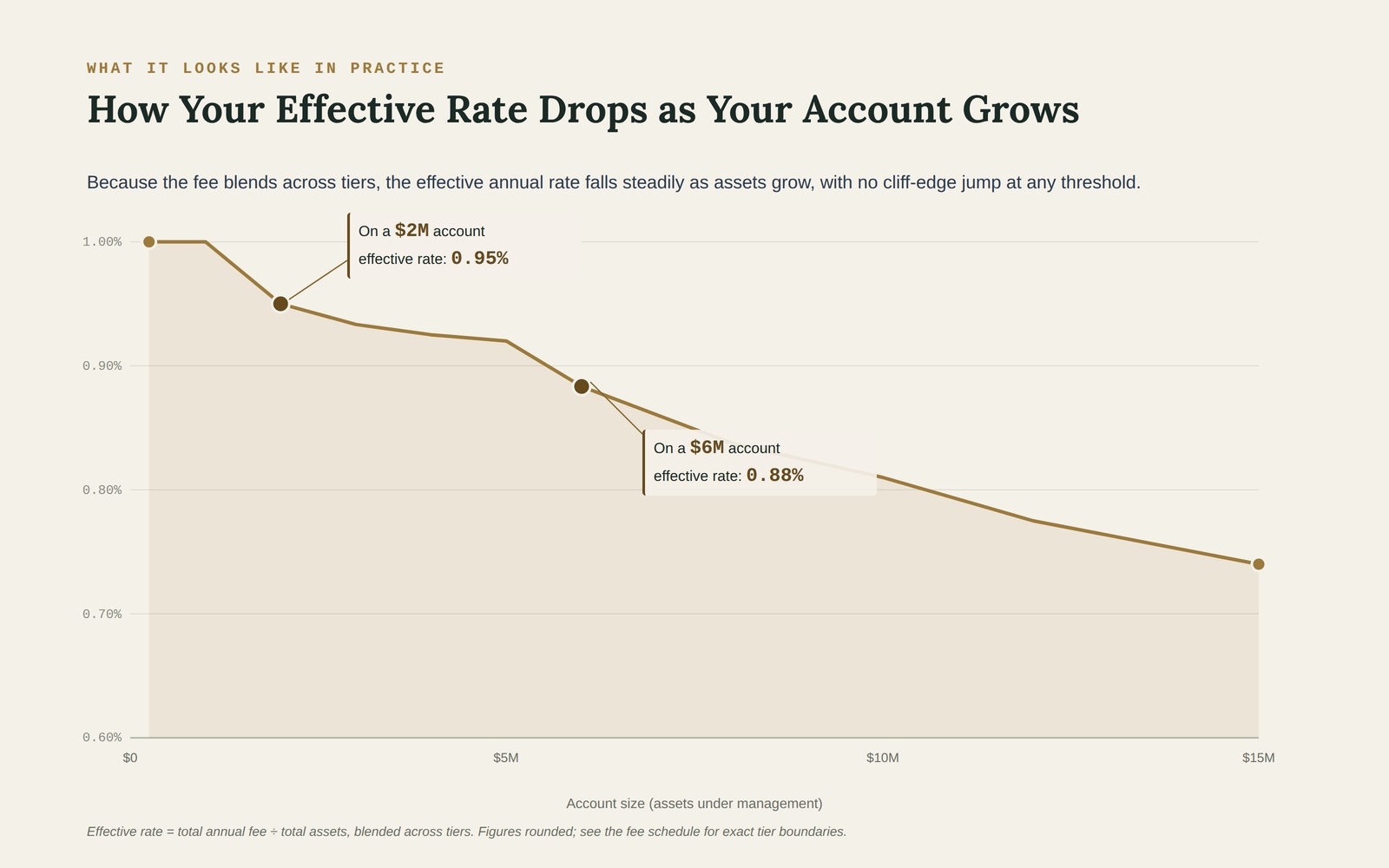
A $2,000,000 account: 1.00% on the first $1,000,000, 0.90% on the remaining $1,000,000. That’s a blended annual fee of $19,000, about 0.95% overall.
A $6,000,000 account: 1.00% on the first $1,000,000 ($10,000), 0.90% on the next $4,000,000 ($36,000), and 0.70% on the remaining $1,000,000 ($7,000). That’s $53,000 total, an effective rate of about 0.88%, lower than the industry median even though the account is well above where most fee schedules start flattening out.
What the Fee Covers, and What It Doesn’t
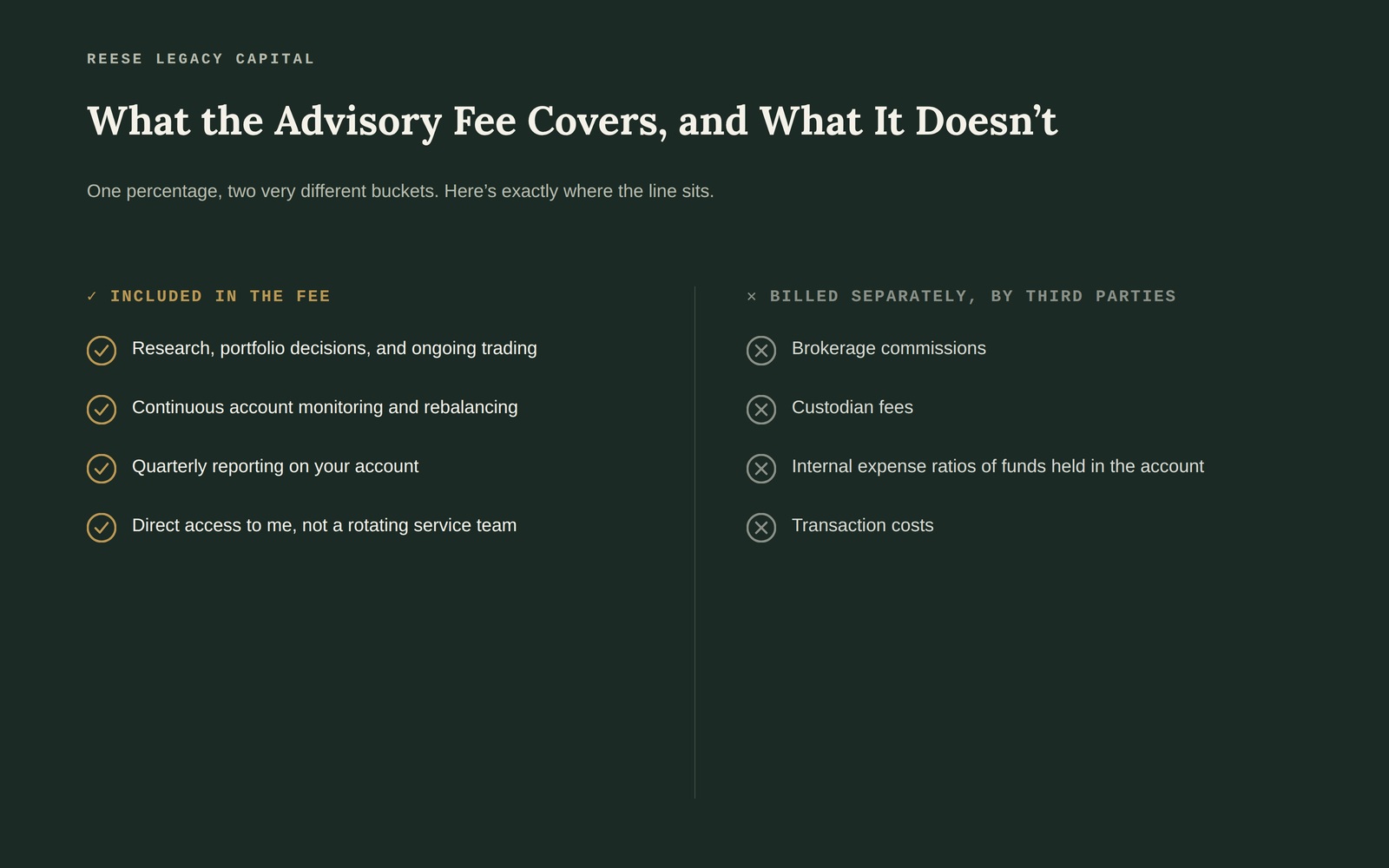
The advisory fee covers ongoing, direct portfolio management: research, decisions, trading, monitoring, and reporting. It does not cover brokerage commissions, transaction costs, custodian fees, or the internal expense ratios of any mutual funds or ETFs held in the account. Those are separate costs charged by third parties, not by Reese Legacy Capital, and they apply no matter which advisor, or platform, you use. Any advisor who quotes a management fee without mentioning these is giving you an incomplete number, not necessarily a dishonest one, but incomplete.
How to Check a Fee Quote Yourself
You don’t need to take any advisor’s word for their fee structure, including this one. Every SEC- or state-registered investment adviser is required to disclose fees in Form ADV Part 2, sometimes called the brochure, which every prospective client is entitled to see before signing an advisory contract. It’s a public document, searchable through the SEC’s Investment Adviser Public Disclosure database, and worth reading before you compare quotes rather than after.
How Reese Legacy Capital Fits
Reese Legacy Capital is an independent, fee-only Registered Investment Adviser based in East Petersburg, serving families throughout Lancaster County. I’m Robert Reese, the founder and only advisor, and a member of the XY Planning Network, NAPFA, and the Fee-Only Network. Fee-only isn’t a marketing label here, it’s the only way I’m paid, which means the fee schedule above is the whole picture, not a starting quote with other compensation layered in behind it. You can see the full pricing detail on the fees page, and if you want to know what this would actually look like for your account, start a conversation and I’ll walk through it directly. For the broader question of what to look for in an advisor beyond cost, Financial Advisor in Lancaster, PA: How to Choose One covers credentials, fee structures, and red flags in more depth. And if you’re weighing whether a human advisor is worth the cost at all compared to a robo-advisor or DIY investing, How Much Does a Financial Advisor Actually Cost? covers that side of the question.
Frequently Asked Questions
Is a 1% fee normal for a financial advisor?
Yes. Industry-wide, the median AUM-based advisory fee is close to 0.96% annually, with most advisors charging near 1% for accounts in the $500,000–$1,000,000 range. A quote meaningfully above that range is worth asking about directly; a quote meaningfully below it is worth checking for commissions or other compensation layered in elsewhere.
Does a lower percentage always mean a better deal?
Not necessarily. A lower headline percentage on a fee-based account can still come with commissions on specific products, which may cost more overall than a straightforward fee-only percentage. Compare the full picture, not just the advertised rate.
What’s the difference between fee-only and fee-based?
Fee-only means the advisor is paid solely by fees from the client, no commissions from product sales. Fee-based means the advisor charges fees but can also accept commissions, which reintroduces some of the incentive conflict fee-only pricing is designed to remove.
Is the advisory fee the only cost I’ll pay?
No. The advisory fee covers the advisor’s management and planning work. Brokerage commissions, custodian fees, and the internal expenses of any funds held in the account are separate, third-party costs that apply regardless of which advisor you use.
This article is for general educational purposes and is not legal, tax, or investment advice. Fee schedules are subject to the terms of a signed Advisory Contract, and no fee increase takes effect without prior client consent. Investment advisory services are offered by Reese Legacy Capital, LLC only in states where it is properly registered or excluded or exempted from registration requirements. For complete fee and conflict-of-interest disclosure, refer to Reese Legacy Capital’s Form ADV Part 2.