
Most people have heard of the federal estate tax and assume it is the thing to plan around. For 2026, that tax only applies above $15 million per person, so it never touches the vast majority of families. Pennsylvania’s inheritance tax is a different matter. It has no exemption threshold at all. Whether the estate is worth $30,000 or $3 million, if the assets go to a taxable beneficiary, the tax applies from the first dollar. For Lancaster County families, many of whom are passing down a farm, a family business, or a home that has stayed in the family for generations, this is usually the tax that actually matters.
This guide covers how the tax works, what it actually applies to, what is exempt, and where people commonly get it wrong.
A note on who is telling you this: I am a registered investment adviser, not a CPA or a tax attorney. Everything below is a general overview to help you understand how Pennsylvania’s inheritance tax works and to have a more informed conversation, not a substitute for advice from your own CPA or estate planning attorney. Inheritance tax involves your specific assets, your family situation, and details a general guide cannot account for, so any actual filing, planning, or tax decision should go through a qualified tax professional.
The Rates: What You Actually Pay, by Relationship
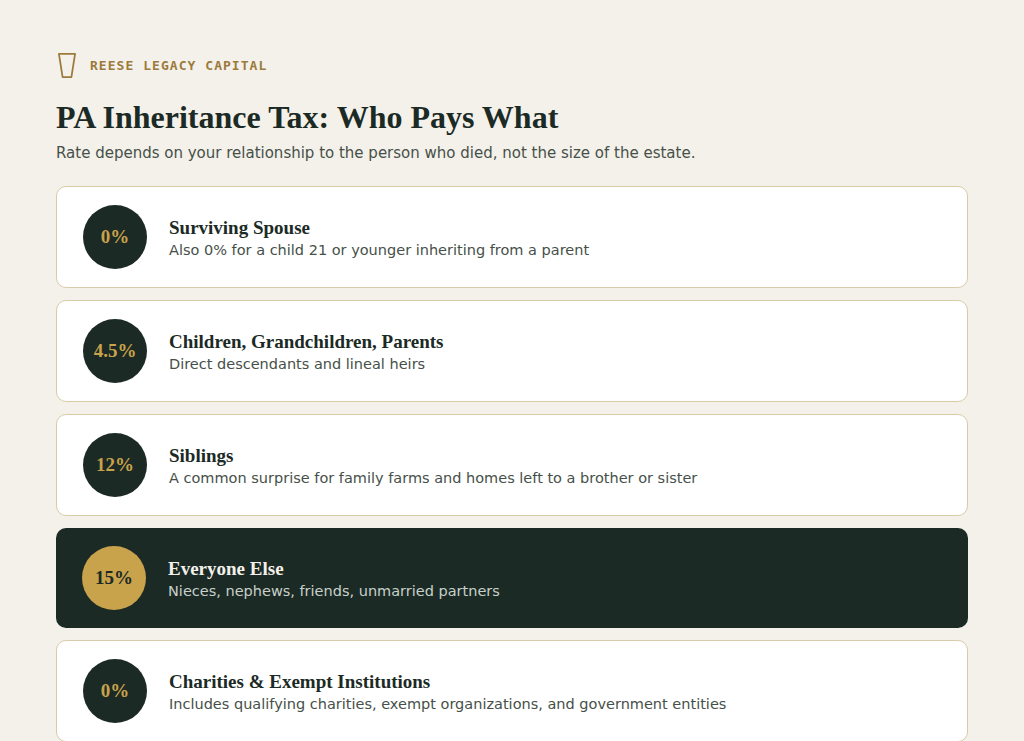
Pennsylvania’s inheritance tax rate depends entirely on the relationship between the person who died and the person receiving the assets, not on the size of the estate:
- 0%: transfers to a surviving spouse, and transfers from a parent to a child who was 21 or younger at the time of the parent’s death.
- 4.5%: transfers to direct descendants and lineal heirs, meaning children (over 21), grandchildren, parents, and grandparents.
- 12%: transfers to siblings.
- 15%: transfers to everyone else, including nieces, nephews, friends, and unmarried partners.
- 0%: transfers to qualifying charities, exempt institutions, and government entities.
That 12% sibling rate surprises a lot of families, especially in Lancaster where it is common for a farm or family home to pass to a brother or sister rather than directly to children. It is worth planning around specifically, not assuming it works the same as a transfer to a child.
What’s Actually Taxed
For a Pennsylvania resident, the tax reaches two different categories of property, and they are treated differently based on location:
Real estate and tangible personal property located in Pennsylvania is taxable. Real estate located outside Pennsylvania is not subject to Pennsylvania inheritance tax at all, even for a Pennsylvania resident.
Intangible property, meaning stocks, bonds, bank accounts, and similar assets, is taxable regardless of where it is held. A brokerage account at a national firm is taxed the same as one at a Lancaster bank.
That distinction catches people off guard in both directions: a vacation property in another state escapes the tax entirely, while investment accounts held anywhere in the country do not.
What’s Exempt
A few categories fall outside the tax entirely, and knowing them matters for how an estate gets structured:
- Life insurance proceeds paid to a named beneficiary.
- Property owned jointly between spouses, including real estate held as tenants by the entireties.
- The family exemption, a $3,500 exemption available to a qualifying spouse or household member.
- Qualifying family farms and certain family-owned business interests, when transferred to eligible family members who continue to operate the business, subject to specific conditions.
Retirement Accounts: A Nuance Worth Understanding
Retirement accounts get treated differently depending on the age of the person who died. If you were 59½ or older at your death, the retirement accounts you leave behind are generally subject to Pennsylvania inheritance tax. If you had not yet reached 59½, those same accounts are generally not taxed. It is one of the few places in the tax code where a single age threshold changes the outcome this directly, and it is worth knowing if you are doing any planning around when and how retirement assets get distributed.
Gifts Before Death: The One-Year Lookback
Giving assets away before death is not a simple way around this tax. Pennsylvania pulls gifts made within one year of death back into the taxable estate, with a limited exclusion of $3,000 per recipient per calendar year. Gifting can still be a legitimate part of a longer-term plan, but it needs to happen well before death to be effective, and it is worth discussing with your attorney or advisor rather than assuming a deathbed gift will avoid the tax.
Filing and Payment: Deadlines and the 5% Discount
The Pennsylvania inheritance tax return (REV-1500) is due nine months after the date of death, and that is also when payment is generally due. Pennsylvania offers a meaningful incentive to move faster: a 5% discount on the tax if it is paid within three months of death, well before the return itself is due. For an estate with a sizable tax bill, that discount is often worth coordinating for, especially since it does not require the full return to be finalized first, only a reasonable payment on account.
A Common Misconception: Trusts and This Tax
People sometimes assume that because a revocable living trust avoids probate, it also avoids Pennsylvania inheritance tax. It does not. Assets held in a revocable trust are still included in the taxable estate and taxed the same as if they had passed through a will, because you still controlled them during your lifetime. A trust offers real advantages, privacy, avoiding probate, control over distributions, but reducing this particular tax generally is not one of them for a standard revocable trust. Certain irrevocable trust strategies can affect the outcome, but that is a technical, attorney-driven decision, not something to assume by default.
Why This Hits Differently in Lancaster County
The mechanics of this tax are the same statewide, but the stakes look different here than in a typical suburban estate. Family farms, multi-generational real estate, and closely held family businesses are common in Lancaster County, and they tend to be the assets people are least prepared to sell quickly to cover a tax bill. A farm passing to a sibling instead of a child can mean the difference between a 4.5% and a 12% rate on the same land. Planning ahead, coordinating with the attorneys and CPAs already involved in the estate, and understanding what qualifies for the family farm or business exemption before the transfer happens, rather than after, is where the real savings tend to show up.
How This Fits Into Your Broader Wealth Plan
Pennsylvania inheritance tax planning is not a standalone exercise. It intersects with how your accounts are titled, whether a trust is part of your plan, how retirement accounts are structured, and how a family business or farm is set to transfer. As your investment adviser, my role is to make sure the assets I manage support that plan, not to calculate or file the tax itself, that belongs with your CPA and estate planning attorney, and I regularly coordinate directly with those professionals as part of the relationship. If you want to talk through how this applies to your situation, and get connected with the right tax and legal professionals if you do not already have them, start a conversation.
Frequently Asked Questions
Does Pennsylvania have a separate estate tax in addition to the inheritance tax?
No. Pennsylvania does not currently impose a separate state estate tax. The inheritance tax is the primary state-level tax on transfers at death, and it applies in addition to, not instead of, the federal estate tax for the small number of estates large enough to owe federal tax.
Does a will avoid Pennsylvania inheritance tax?
No. A will determines who receives your assets, but it does not change whether those transfers are taxed. The tax applies based on your relationship to the recipient, regardless of whether the assets pass through a will, a trust, or beneficiary designations.
Who actually pays the tax, the estate or the person inheriting?
In practice, the tax is typically paid out of the estate before distributions are finalized, though the tax is technically assessed based on each beneficiary’s relationship to the decedent. The executor or administrator is generally responsible for filing the return and arranging payment.
What if I inherit from someone who lived in another state?
Pennsylvania inheritance tax generally applies based on where the decedent lived and where their real estate is located, not where the beneficiary lives. If you live in Pennsylvania but inherit from a relative who lived and owned property entirely in another state, Pennsylvania inheritance tax typically does not apply to that inheritance, though the other state’s rules might.
Can I just give assets away before I die to avoid this tax?
Gifts made within one year of death are pulled back into the taxable estate, aside from a limited $3,000 per-recipient annual exclusion. Gifting further in advance can still reduce the eventual tax, but it needs to be part of a deliberate, longer-term plan, not a last-minute move.
This article is for general educational purposes and is not legal or tax advice. Pennsylvania inheritance tax rules involve specific facts, exemptions, and exceptions beyond the scope of this guide. Reese Legacy Capital, LLC does not provide legal or tax advice; consult a qualified estate planning attorney and tax professional regarding your specific situation. Investment advisory services are offered by Reese Legacy Capital, LLC only in states where it is properly registered or excluded or exempted from registration requirements.