

Maybe it started with company stock from your job. Maybe you bought early, held on, and watched one position grow until it became a big piece of everything you own. That’s a good problem to have. It’s still a problem.
This guide walks through what counts as a concentrated stock position, why it carries more risk than it feels like it does, and seven common ways people reduce that risk without handing a huge share of their gains to taxes.
The short version
- Many advisers treat any one stock above about 10% of your investable assets as concentrated. Above 25%, one company’s bad year can change your plans.
- Single stocks fail more often than most people expect. About 4 in 10 stocks in the Russell 3000 suffered a permanent drop of 70% or more between 1980 and 2014.
- You don’t have to sell everything at once. Gradual selling, tax-aware timing, gifting, exchange funds and options strategies can all help.
- Most good plans combine a few of these. The right mix depends on your taxes, your timeline and how much risk you can live with.
What is a concentrated stock position?
There’s no official cutoff, but many advisers treat any single stock that makes up more than about 10% of your investable assets as concentrated.
| How much is in one stock | What it usually means |
|---|---|
| Under 10% | Typical for a diversified portfolio |
| 10% to 25% | Concentrated. Worth having a plan |
| Over 25% | Highly concentrated. One company’s bad year can change your retirement |
Concentration usually builds quietly:
- Employer stock from RSUs, stock options, an ESPP or a 401(k) match.
- A long-time winner that grew faster than everything else you own.
- An inheritance of a single stock that a parent held for decades.
- Conviction. You know the company well and keep adding.
Why one stock is riskier than it feels
The stocks we own feel familiar, and familiar feels safe. The long-term data says otherwise.
J.P. Morgan studied every stock in the Russell 3000 Index from 1980 to 2014. Roughly 40% of them suffered a permanent decline of 70% or more from their peak, and about two-thirds did worse than the index itself, according to its “The Agony & The Ecstasy” study. Past performance does not guarantee future results.
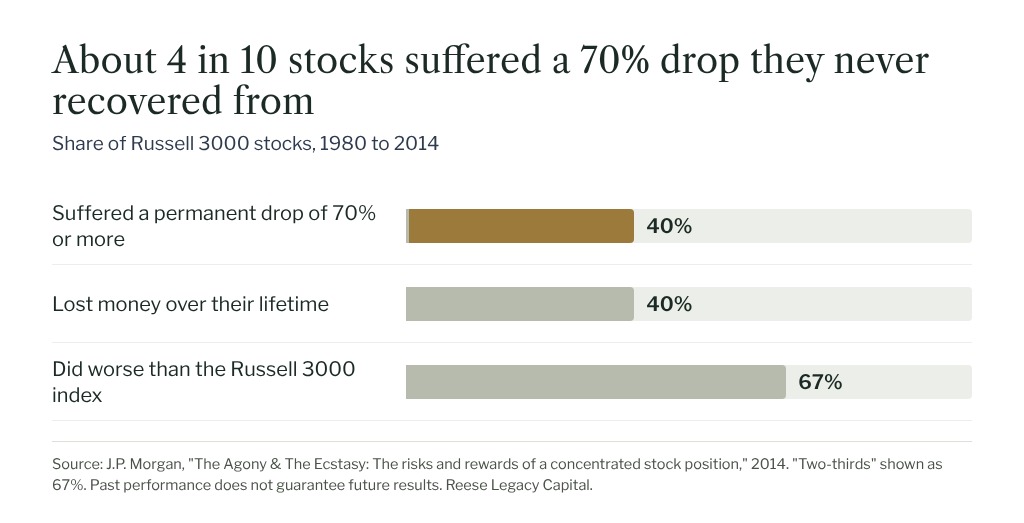
That doesn’t mean your stock will be one of them. It means a single company can go wrong in ways no one sees coming: a lawsuit, a failed product, a new competitor, an accounting problem. A diversified portfolio can absorb that kind of hit. A concentrated one often can’t.
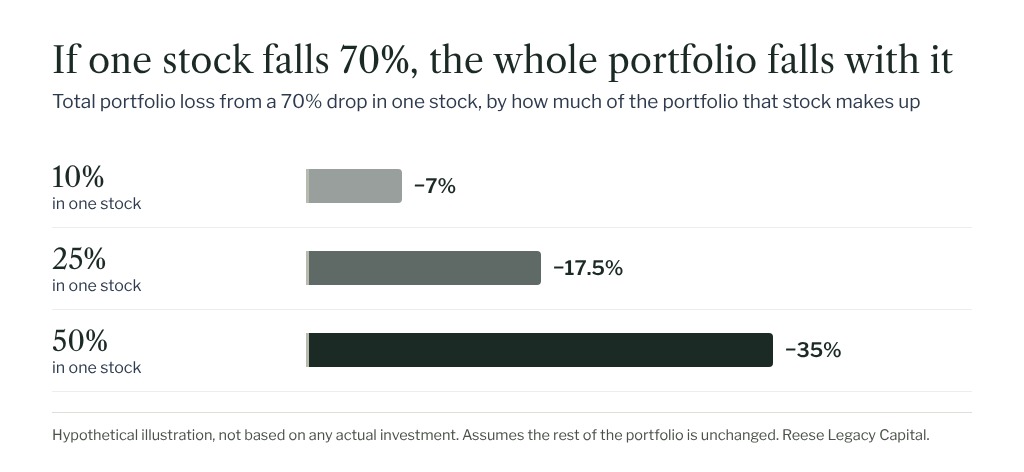
The bigger the position, the more of that drop lands on everything you own. If the stock is your employer’s, the risk doubles up. A rough stretch for the company can hit your paycheck and your savings at the same time.
1. Sell gradually on a schedule
The simplest approach is to sell a set amount on a set schedule: monthly, quarterly, or a fixed percentage each year. A schedule takes emotion out of it, spreads your sales across different prices, and can spread the tax bill across several tax years.
Here’s how a simple schedule works if one stock starts at 40% of a portfolio and a quarter of the original shares is sold each year:
| Year | Shares sold | One stock as a share of the portfolio |
|---|---|---|
| Start | None | 40% |
| Year 1 | 25% of the original position | 30% |
| Year 2 | 25% | 20% |
| Year 3 | 25% | 10% |
| Year 4 | 25% | 0% |
Hypothetical. Assumes prices stay flat and sale proceeds are reinvested in a diversified portfolio. Many people stop at a target, such as 10%, instead of selling everything.
Company insiders who often have access to nonpublic information can do this through a Rule 10b5-1 trading plan, which sets up future sales in advance.
2. Pay attention to holding periods
How long you’ve owned the shares changes the tax bill:
| How long you’ve held the shares | Type of gain | Federal tax rate |
|---|---|---|
| More than one year | Long-term | 0%, 15% or 20%, depending on income, plus a possible 3.8% net investment income tax |
| One year or less | Short-term | Your ordinary income tax rate |
If some of your shares are a few weeks away from the one-year mark, waiting can make a real difference. If you bought at different times, selling specific high-cost lots first can also lower the gain you realize.
3. Pair sales with tax losses
If you have losing positions elsewhere in your portfolio, selling them in the same year can offset gains from trimming your concentrated stock. Net capital losses beyond your gains can offset up to $3,000 of ordinary income each year, and the rest carries forward.
One rule to know: if you buy the same or a substantially identical security within 30 days before or after selling it at a loss, the wash sale rule delays that loss.
4. Give appreciated shares instead of cash
If you already give to charity, donating appreciated shares you’ve held for more than a year can be more efficient than writing a check. In general, you can deduct the fair market value of the shares and avoid paying capital gains tax on the growth. A donor-advised fund lets you make the gift now and choose the charities later.
Gifting shares to family members works differently. They generally take over your cost basis, so the gain moves to them rather than disappearing. That can still help if they’re in a lower tax bracket, but the rules for gifts to children and the annual gift exclusion are worth reviewing first.
5. Consider an exchange fund
An exchange fund pools concentrated stock from many investors into one diversified portfolio. You contribute your shares and receive a share of the fund, without selling and triggering tax at that point.
The trade-offs are real: exchange funds are generally limited to investors who meet high wealth thresholds, they typically require you to stay in for about seven years, and they carry their own fees.
6. Hedge with protective puts or a collar
If you aren’t ready to sell, options can limit how much you could lose:
- Protective put: buying a put option gives you the right to sell your shares at a set price, which puts a floor under the position for a period of time. You pay a premium for that protection.
- Collar: you buy a protective put and sell a covered call at the same time. The call premium helps pay for the put. In exchange, you give up gains above the call’s strike price.
A collar that’s set too tight can be treated as a sale for tax purposes, so the strike prices matter.
7. Generate income with covered calls
Selling a covered call means selling someone the right to buy your shares at a set price by a set date. You collect the premium either way. If the stock rises above that price, your shares may be called away, which is effectively a planned sale at a price you chose.
Covered calls can produce income while you wait to diversify, but they cap your upside, don’t protect against a large drop, and can trigger a taxable sale if your shares are called away.
Special cases
- Employer stock in a 401(k): if your plan holds highly appreciated company stock, a strategy called net unrealized appreciation (NUA) may let you pay long-term capital gains rates on that growth instead of ordinary income rates when you leave the plan. The rules are strict, so review it before rolling anything over.
- Inherited shares: inherited stock generally receives a step-up in cost basis to its value at the date of death, so diversifying soon after inheriting can cost little or nothing in taxes.
The seven strategies at a glance
| Strategy | Lowers concentration? | Taxes now? | Keeps upside? | Main trade-off |
|---|---|---|---|---|
| Sell on a schedule | Yes, gradually | Yes, spread over several years | On the shares you keep | Takes time |
| Watch holding periods | Helps your sales | At lower long-term rates | Yes | May mean waiting a few weeks |
| Pair with tax losses | Helps your sales | Gains offset by losses | Yes | Wash sale rule applies |
| Give shares to charity | Yes | No capital gains tax on the gift | No, the shares are given away | Makes sense only if you already give |
| Exchange fund | Yes | Deferred | Through the fund | High wealth thresholds, about a seven-year hold, fees |
| Protective put or collar | No, it hedges the position | Usually not | A collar caps it | Option costs; tax rules on tight collars |
| Covered calls | No | On premiums, and if shares are called away | Capped above the strike | No protection from a big drop |
Building a plan
Most people don’t use just one of these strategies. A typical plan combines a few of them: a target for how much of your net worth you want in any one stock, a selling schedule, a look at holding periods and losses each year, and a hedge or covered calls on what’s left.
The right mix depends on your tax situation, how soon you need the money, and how much of your future you’re comfortable tying to one company. If a big piece of your portfolio is in one stock, it helps to talk it through before you act.
This article is for general educational purposes only and is not individualized investment, tax or legal advice. It is not a recommendation to buy, sell or hold any security or to use any particular strategy. Tax rules are complex and change over time; consult a qualified tax professional about your situation. Options involve risk and are not suitable for every investor; before trading options, read Characteristics and Risks of Standardized Options, available from the Options Clearing Corporation. Investing involves risk, including possible loss of principal. Reese Legacy Capital, LLC is a registered investment adviser in the Commonwealth of Pennsylvania. Registration does not imply a certain level of skill or training.

Robert Reese
Founder of Reese Legacy Capital, a fee-only fiduciary adviser in Lancaster County, PA. About Robert
Portfolio management
Questions about your own portfolio?
A direct conversation with the person who would manage it: where you are, what you hold, and whether our approach makes sense for you.