
Most people hear “legacy planning” and think it means the same thing as estate planning from getting a will drawn up, naming some beneficiaries, and it’s done. That’s part of it, but it’s the smaller part. The families I work with in Lancaster County who do this well are planning for two things at once: what happens to their money, and what happens to everything else that made their family theirs. Here’s how I think about both.
What family legacy planning actually means
Legacy planning starts with the same legal building blocks as estate planning: a will, the right trusts, updated beneficiary designations, powers of attorney, and healthcare directives. If any of those are missing or out of date, nothing else in this article matters much until they’re fixed.
But legacy planning asks a broader question than “who gets what”: what do you want to still be true about your family in twenty or fifty years?
That’s a values question as much as a financial one, and it’s the piece that a generic estate plan, the kind you can get from a template service, usually never touches.
The financial building blocks
A handful of tools do most of the actual work of transferring wealth across generations:
Trusts let you control not just who receives assets, but when and how, which matters enormously if you’re providing for young children, a family member who needs extra protection, or simply want assets managed by a professional rather than distributed as a lump sum. I’ve written separately about how a trustee actually works if you want the deeper mechanics.
Beneficiary designations on retirement accounts and life insurance override what your will says. These could be years out of date when I start working with a new family, still naming an ex-spouse or a sibling who’s no longer part of the plan.
Lifetime gifting including newer tools like education accounts and the new federal Trump Accounts for children, moves wealth to the next generation earlier and can reduce what’s left in a taxable estate later. I broke down who’s eligible for a Trump Account in a separate piece.
The federal estate tax exemption is higher right now than it’s ever been: as of 2026, the One Big Beautiful Bill Act permanently set it at $15 million per person, $30 million per married couple, with no scheduled sunset. That single change means the overwhelming majority of families reading this will never owe a dollar of federal estate tax.
The part that actually affects most Lancaster County families: PA inheritance tax
Here’s the thing the $15 million federal number can quietly obscure, Pennsylvania has its own inheritance tax, separate from the federal estate tax, and it applies regardless of how large or small the estate is. There’s no PA exemption threshold in the way there is federally. If you’re leaving anything to anyone other than a spouse, this is very likely the tax that actually matters for your family.
Pennsylvania’s inheritance tax is charged to the beneficiary, based on their relationship to you:
- Spouses: 0% — fully exempt
- Children age 21 or younger inheriting from a parent: 0%
- Children, grandchildren, and other lineal heirs: 4.5%
- Siblings: 12%
- Everyone else — nieces, nephews, friends, unmarried partners: 15%
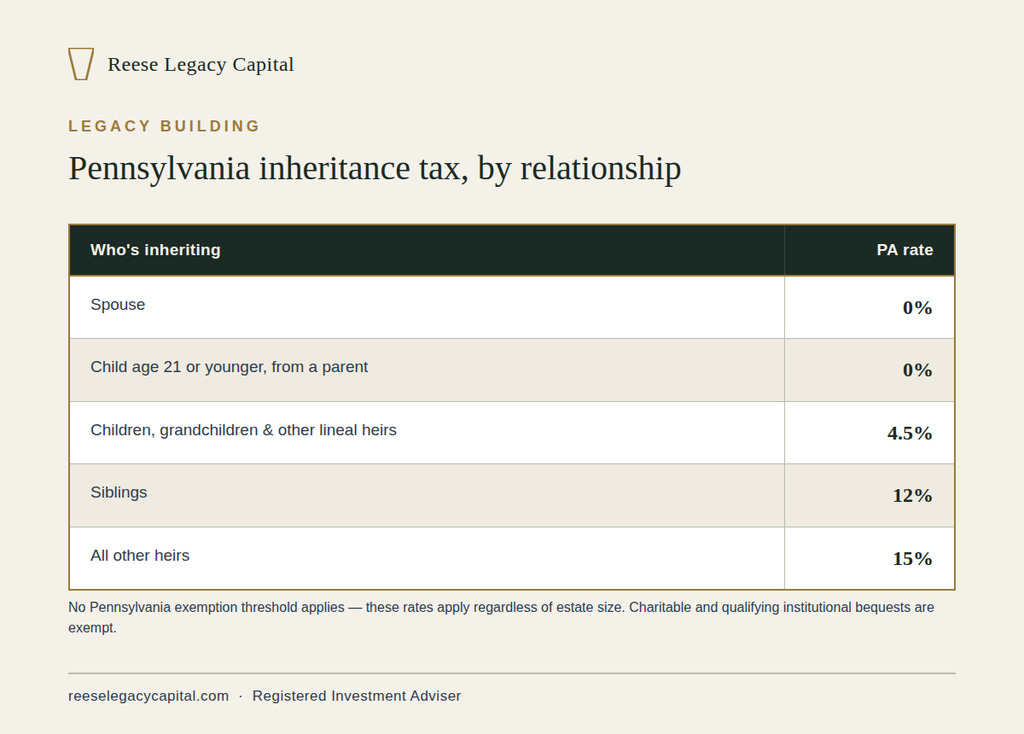
Payment is due within nine months of death, with a 5% discount if it’s filed within three. Charitable bequests, and transfers to qualifying religious, educational, or governmental organizations, are exempt.
A quick note: I’m an investment adviser, not a CPA or tax attorney. The rates above are accurate as of publication, but your actual liability depends on your specific estate, and I’d always recommend confirming numbers with a tax professional before making decisions based on them.
The practical takeaway: who you name as a beneficiary, and how you structure what they receive, has a direct and immediate tax consequence in Pennsylvania, even for estates that federal law now mostly ignores. This is exactly the kind of detail that gets missed by a national template or an out-of-state advisor who isn’t thinking in Pennsylvania terms.
Legacy beyond the dollars
The families I respect most in this work aren’t only trying to transfer wealth efficiently, they’re trying to make sure their kids and grandkids inherit how they think about money, not just the money itself.
That can take a formal shape, like an ethical will, a non-binding letter that sits alongside your legal documents and explains your values, the story of how the family built what it has, and what you hope it’s used for. It can also just be a conversation you have proactively, rather than one your kids have to guess at after you’re gone.
For me, that starts with faith, it’s what keeps me rooted in how I try to lead my day-to-day life, whether that’s how I invest for my own family, how I manage the Reese Family Trust, or simply how I try to show up as a father.
Legacy planning, at its core, is an extension of that same instinct: deciding now what you want to still be true for the people you love long after you’re not there to say it yourself.
Why work with someone local
A Lancaster-based fiduciary isn’t just a matter of convenience. Pennsylvania inheritance tax, the specific PA trust and probate process, and the local attorneys and CPAs your plan needs to coordinate with are all things a national call-center advisor simply isn’t positioned to think about the way someone practicing here every day is.
As a fee-only fiduciary registered in Pennsylvania, I coordinate directly with your estate attorney and CPA rather than working around them, your legacy plan should be one plan, not three disconnected ones.
Frequently asked questions
Do I need a trust if my estate is under the federal exemption? Often, yes. Trusts aren’t just an estate-tax tool, they control timing, protect beneficiaries who aren’t ready for a lump sum, and can help your estate avoid probate. With the federal exemption at $15 million, most people who still use trusts are doing it for control and protection, not tax avoidance.
Does Pennsylvania inheritance tax apply to retirement accounts? Certain retirement assets have special treatment depending on the beneficiary and the account type, this is genuinely worth reviewing with your specific accounts and beneficiaries rather than assuming a blanket answer.
What’s the difference between legacy planning and estate planning? Estate planning is the legal and financial mechanics. The will, the trusts, are the beneficiary forms. Legacy planning includes all of that, plus the intentional work of deciding what values, stories, and expectations you want to pass down alongside the assets.
Where do I actually start? With whatever is most out of date: if you don’t have a will, start there. If you have one but haven’t reviewed it in five-plus years, or your family has changed since it was written, that’s your starting point instead.
If you’re in Lancaster County and want to talk through what a family legacy plan should actually look like for your family, I’m glad to have that conversation.
This article is for general informational and educational purposes only and does not constitute legal, tax, or personalized investment advice. Estate and inheritance tax law is subject to change at both the federal and state level; consult a qualified estate attorney and tax professional for guidance specific to your situation. Registration as an investment adviser does not imply a certain level of skill or training.