
Since I wrote about whether Trump Accounts are worth it, the question I’ve actually been getting is narrower and more practical: does my child even qualify, and for how much? Here’s a straight answer, including the one distinction that trips most people up — who can have an account versus who gets the free money in it.
Who can have a Trump Account
Any child under age 18 with a Social Security number can have a Trump Account opened for them. That’s the baseline eligibility for the account itself, and it’s broader than a lot of the early coverage suggested.
Who gets the $1,000 government seed money
This is the part worth separating out clearly: the one-time $1,000 government seed contribution is not available to every child with an account — it’s specifically for U.S. citizens born between January 1, 2025 and December 31, 2028, and it requires filing a tax election to claim it. A child born outside that window can still have a Trump Account opened and funded by family, but won’t receive the automatic government deposit. Only one funded Trump Account is allowed per child, so there’s no way to claim the seed money more than once by opening multiple accounts.
How much can go in each year
Total contributions from all sources are capped at $5,000 per child per year, combined — not $5,000 per contributor. There’s an important carve-out: the government’s $1,000 seed contribution and qualified contributions from charitable organizations don’t count against that annual limit, so a family isn’t losing contribution room to the seed deposit itself.
Who’s allowed to contribute
The list of who can put money in is broader than most tax-advantaged accounts:
Any adult — parents, grandparents, other family members — can contribute directly.
Employers can contribute up to $2,500 per year per employee’s child, which is a genuinely useful benefit for a small business owner to know about, whether offering it to employees or receiving it as one.
States, local governments, and qualifying 501(c)(3) charities can also contribute, and those contributions are excluded from the annual cap the same way the seed money is.
Employees can direct pre-tax salary deferrals into the account through an employer plan, where offered.
Trump Accounts vs. 529 plans and custodial Roth IRAs
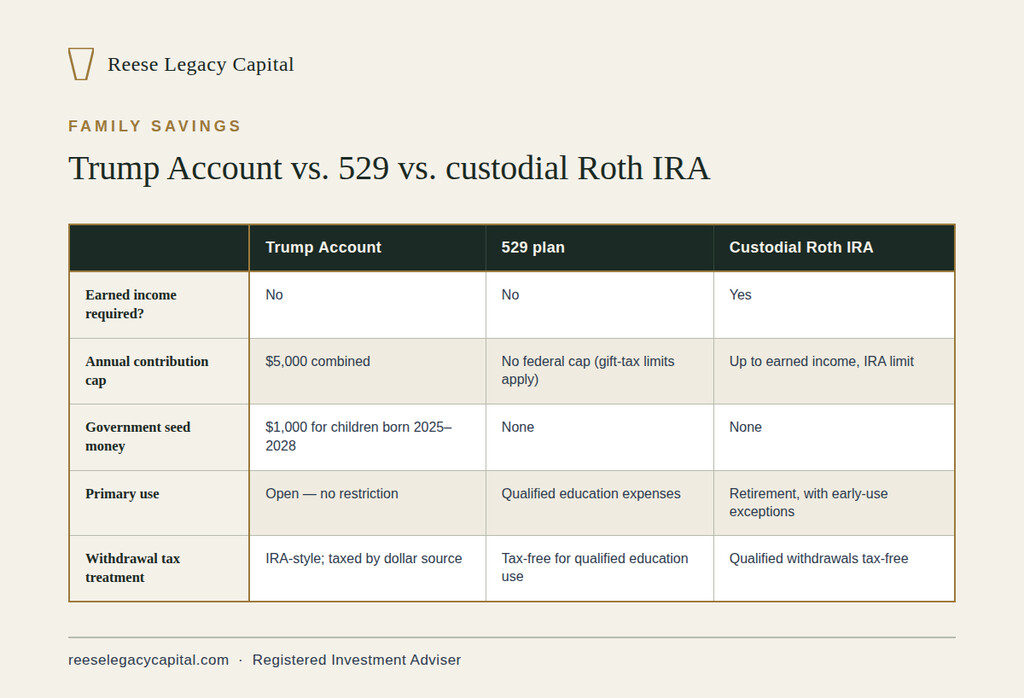
The comparison people usually want is against the two accounts already familiar to most families:
Versus a 529 plan: a 529 is purpose-built for education, with tax-free withdrawals when used for qualified education expenses. A Trump Account isn’t restricted to education at all, but in exchange, money generally can’t come out before age 18 under any circumstances — there’s no equivalent to a 529’s qualified-expense carve-out.
Versus a custodial Roth IRA: a Roth IRA for a minor requires the child to have earned income, which rules it out for most young kids. A Trump Account has no earned-income requirement, so it’s usable from birth. The tradeoff is on the back end — Roth IRA qualified withdrawals can be entirely tax-free, while Trump Account withdrawals are taxed depending on which dollars they came from (more below).
Trump Accounts also come with a narrower investment menu by design — low-cost index funds only, with expense ratios capped at 0.10%, rather than the open investment choice available inside most brokerage-based 529 or custodial accounts.
Taxes and withdrawal rules
Generally, no withdrawals are allowed before the beneficiary turns 18. After that, the account follows IRA-style distribution rules, which means the tax treatment depends on where the money came from: after-tax contributions made by an individual aren’t taxed again on withdrawal, but the government’s seed contribution, charitable contributions, and any pre-tax salary deferrals are taxable when withdrawn, along with earnings. A handful of exceptions common to IRA-style accounts — including for education, a first home, or disability — may apply, similar to how early-withdrawal exceptions work for retirement accounts.
How and when to open one
Trump Accounts become available starting July 4, 2026. Families will be able to make the tax election either through IRS Form 4547 or directly at trumpaccounts.gov once elections open. Given this is a brand-new federal program, some administrative details are still being finalized by Treasury and the IRS — worth confirming the current rules directly before you file, rather than relying solely on any single article, including this one.
Frequently asked questions
Does my child need earned income to have a Trump Account? No — this is one of the real advantages over a custodial Roth IRA. There’s no earned-income requirement at all.
Is there an income limit for parents who want to contribute? Based on the guidance available so far, contribution eligibility isn’t means-tested by parental income the way some other benefits are — but confirm current rules before relying on this, since program details can still be updated.
My child was born before 2025 — can we still open an account? Yes, an account can still be opened and funded by family contributions; your child simply won’t qualify for the automatic $1,000 government seed deposit, which is tied specifically to that 2025–2028 birth window.
Should we use a Trump Account instead of a 529 or Roth IRA? It depends on what you’re actually saving for and your child’s situation — this is genuinely a “compare all three against your specific goals” question rather than one with a universal answer. Happy to walk through it against your family’s actual plan.
This article is for general informational and educational purposes only and does not constitute personalized tax or investment advice. Trump Accounts are a new federal program; rules, forms, and administrative details may be updated by the Treasury Department and IRS before and after the program’s July 2026 launch. Consult a qualified tax professional before making contribution or withdrawal decisions. Registration as an investment adviser does not imply a certain level of skill or training.