
Not everyone needs a trust. That is not the answer most estate planning content gives you, because “here are 8 great reasons to get a trust” is an easier article to write than “here is how to tell if you actually need one.” For plenty of Pennsylvania families, a properly drafted will, the right beneficiary designations, and jointly titled property already accomplish what they need. For others, skipping a trust means the estate walks straight into the parts of Pennsylvania probate that are genuinely slow, public, and avoidable. This guide is about telling the difference.
A note on who is telling you this: I am a registered investment adviser, not an estate planning attorney. This guide will help you show up to that attorney conversation with better questions, not replace it. Whether you actually need a trust, and which type, is a legal decision that depends on how Pennsylvania law applies to your specific assets and family, and it belongs with a qualified attorney.
What a Trust Actually Solves in Pennsylvania
The core thing a trust solves here is Pennsylvania probate, specifically. A simple, uncontested Pennsylvania estate typically takes 9 to 12 months to close, largely because that timeline is tied to the nine-month deadline for filing the Pennsylvania inheritance tax return. A more complex estate, disputed, hard to value, or tax-complicated, routinely runs 18 months or longer. Along the way, the estate incurs Register of Wills filing fees, appraisal costs, a newspaper notice to creditors, and typically an executor commission benchmarked around 5% of the estate’s gross value, all before beneficiaries see a distribution. Assets properly held in a trust skip this process entirely.
What a trust does not solve is Pennsylvania inheritance tax. That tax applies based on your relationship to the beneficiary, regardless of whether assets pass through a will, a trust, or a beneficiary designation. A revocable trust changes the process your estate goes through. It generally does not change the tax bill.
Signs You Probably Need a Trust
A few situations come up often enough that a trust is usually worth the conversation:
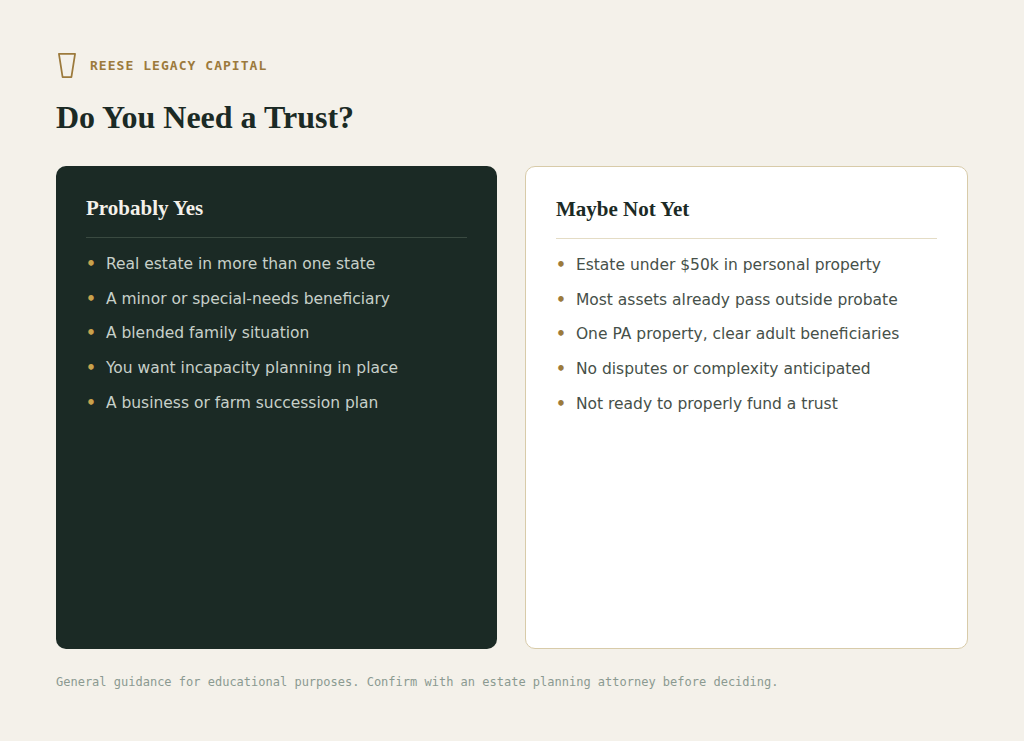
- You own real estate in more than one state. Pennsylvania real estate passing by will still goes through Pennsylvania probate, and property in a second state can trigger a separate probate proceeding there too. A trust consolidates this under one set of instructions.
- You have a minor child or a beneficiary who is not ready to manage a lump sum, whether due to age, spending habits, or a disability that involves means-tested government benefits.
- You are part of a blended family, where a straightforward will risks unintentionally disinheriting a current spouse or children from a prior relationship.
- You want a plan for incapacity, not just death. A revocable trust already has a successor trustee in place to step in immediately if you become unable to manage your affairs, without a court-supervised guardianship proceeding.
- You own a business or a farm with a succession plan that depends on specific timing or conditions a simple will cannot express.
- Privacy matters to you. A will becomes a public record once filed. A trust generally does not.
Signs You Might Not Need One Yet
A trust is not automatically the right answer either. It is worth pausing if:
- Your estate is small. Pennsylvania offers a simplified small estate petition process for estates with $50,000 or less in qualifying personal property, generally excluding real estate. It is faster, cheaper, and skips the newspaper notice requirement that standard probate requires.
- Most of what you own already passes outside probate, through joint ownership with survivorship rights, payable-on-death or transfer-on-death designations, or retirement accounts and life insurance with named beneficiaries.
- Your situation is straightforward: one Pennsylvania property, a clear set of adult beneficiaries, no disputes anticipated, and no incapacity planning concerns beyond a standard power of attorney.
- You are not prepared to fund it properly. A trust that is signed but never actually retitled with your assets protects nothing. If you are not going to follow through on the funding step, the upfront cost may not be worth it yet.
The Trade-off, in Plain Terms
A trust has a real upfront legal cost that a simple will does not. What you are weighing it against is not a guarantee, it is a probable avoidance of Pennsylvania’s probate timeline and its associated fees, plus the added benefits above where they apply to you. For a large, complicated, or multi-state estate, that trade generally favors the trust. For a small, simple, single-state estate with clear beneficiaries, it may not, at least not yet. Life changes, and the right answer at 35 with no kids is not always the right answer at 55 with a farm and three heirs.
Why This Question Comes Up More in Lancaster County
Lancaster County estates skew toward exactly the situations above more often than a typical suburban estate: multi-generational farmland, family businesses, and property that has stayed in the family for decades. Those are also the estates where a sibling inheriting a farm instead of a child, or land split across county lines, turns a routine probate into a genuinely slow and expensive one. It is worth having this conversation earlier rather than after the fact.
How to Actually Decide
This is a two-professional conversation, done together rather than in sequence. Your estate planning attorney determines whether a trust makes sense, drafts it, and makes sure Pennsylvania law is applied correctly to your situation. I work alongside that process to make sure the assets I manage are titled and coordinated the way your attorney’s plan actually requires, since a trust that is drafted correctly but never funded accomplishes nothing. If you want to talk through where your situation falls before or alongside that legal conversation, start a conversation.
Frequently Asked Questions
Does everyone in Pennsylvania need a trust?
No. Many Pennsylvania estates are handled perfectly well with a will, correct beneficiary designations, and jointly titled property. A trust becomes more valuable as the estate gets larger, more complex, multi-state, or involves beneficiaries who need more structure than an outright distribution.
Is a trust cheaper than probate in the end?
It depends on the estate. A trust has an upfront drafting cost a simple will does not, but it can avoid Register of Wills fees, appraisal costs, executor commissions, and months of delay that standard Pennsylvania probate involves. For a small, simple estate, probate costs may be modest enough that the trade doesn’t favor a trust. For a larger or multi-state estate, the trust more often pays for itself.
Does a trust protect me from Pennsylvania inheritance tax?
A standard revocable living trust generally does not. Assets in a revocable trust are still part of your taxable estate for Pennsylvania inheritance tax purposes. Certain irrevocable trust strategies can affect the outcome, but that is a technical, attorney-driven decision specific to your situation.
Can I set up a trust myself without an attorney?
You technically can, but a trust that is drafted incorrectly, or one you never properly fund by retitling your assets into it, can fail to accomplish anything while still costing you time and money. Given how much rides on it being done correctly, this is not typically the place to cut corners.
What happens if I create a trust but never fund it?
Assets you never formally retitle into the trust are not covered by it and generally still pass through probate under your will, or under Pennsylvania’s intestacy laws if you have no will covering them. Funding the trust, actually moving accounts and property into its name, is the step that makes it work, and it is easy to leave unfinished.
This article is for general educational purposes and is not legal or tax advice. Whether a trust is appropriate for your situation depends on facts beyond the scope of this guide. Reese Legacy Capital, LLC does not provide legal or tax advice; consult a qualified estate planning attorney and tax professional regarding your specific situation. Investment advisory services are offered by Reese Legacy Capital, LLC only in states where it is properly registered or excluded or exempted from registration requirements.