
Leaving a job, whether by choice, layoff, or retirement, leaves you with a decision about the 401(k) you built up there. It is rarely urgent in the way it feels urgent, but it is easy to get wrong in ways that cost real money: an unnecessary tax bill, a missed deadline, or a tax break given up permanently without realizing it. This guide walks through the actual mechanics of a rollover, the mistakes that show up most often, and how to think about the decision rather than just where to send the paperwork.
A note on scope: I am a registered investment adviser, and rollover decisions, where the money goes and how it gets invested, are squarely what I help with. The tax reporting itself (your 1099-R, how it shows up on your return) is your CPA’s territory, not mine, and it is worth looping them in on anything beyond a straightforward direct rollover.
Your Four Options When You Leave a Job
An old employer plan does not disappear when you leave. You generally have four choices, and none of them is automatically wrong:
- Leave it where it is. Many plans allow former employees to keep their balance in place, assuming it is above the plan’s forced-distribution threshold. Fees, investment options, and service can vary widely from plan to plan.
- Roll it into your new employer’s plan, if the new plan accepts incoming rollovers. This consolidates accounts but ties you to that plan’s investment menu.
- Roll it into an IRA. This is the most common path for someone who wants more control over investment choices and a single account to manage going forward.
- Cash it out. Generally the most expensive option: the distribution is taxable as ordinary income, subject to a 10% early withdrawal penalty if you are under 59½ (with limited exceptions), and, if paid directly from an employer plan, subject to mandatory 20% federal withholding regardless of your actual tax bracket.
Direct Rollover vs. 60-Day Rollover: The Difference That Costs People Money
This is where most expensive mistakes happen, and it comes down to who touches the money.
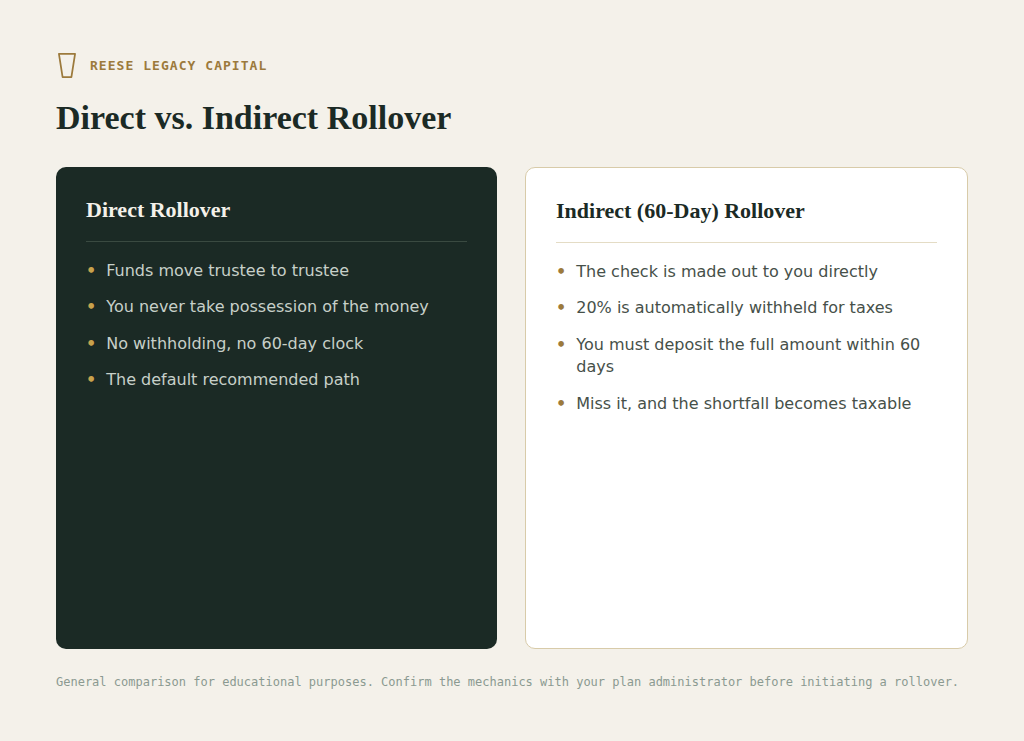
In a direct rollover, your old plan sends the funds straight to the new IRA or plan, trustee to trustee. You never take possession of the money, and no tax is withheld. This is the clean, default-recommended path.
In an indirect rollover, the check is made out to you, and you have 60 days to deposit it into another eligible retirement account. The catch: when an employer plan pays a distribution directly to you, it is required to withhold 20% for federal taxes, even if you fully intend to roll the entire amount over. If you want to complete a full rollover and avoid tax on the withheld portion, you have to come up with that 20% yourself from other funds and deposit the full original balance within the 60 days. Miss the deadline, or roll over only the net check you actually received, and the shortfall becomes taxable income, plus a possible 10% penalty if you are under 59½.
In practice, there is rarely a good reason to choose an indirect rollover over a direct one. A direct rollover avoids this entire problem.
The Once-Per-Year Rule (and Where It Does Not Apply)
The IRS limits you to one indirect, 60-day IRA-to-IRA rollover in any 12-month period, regardless of how many IRAs you own. It is a narrower rule than people assume: it does not apply to direct trustee-to-trustee transfers, and it does not apply to rollovers between an employer plan and an IRA in either direction. A direct rollover from an old 401(k) to an IRA does not use up, or count against, this once-per-year limit.
Rolling Into a Roth Is a Taxable Event
Rolling a traditional 401(k) into a traditional IRA is not a taxable event; you are simply moving pre-tax money between pre-tax accounts. Rolling a traditional 401(k) into a Roth IRA is different: that is a Roth conversion, and the full amount converted is taxed as ordinary income in the year you do it. It can still be the right move depending on your tax situation and time horizon, but it should be a deliberate decision, not something that happens by accident because a form defaulted to the wrong account type.
If You Own Company Stock, Check Before You Roll It Over
This is the piece that gets missed most often, and it can be permanent once it is gone. If your 401(k) holds employer stock that has appreciated significantly, a special rule called Net Unrealized Appreciation (NUA) lets you, if you take the stock as part of a qualifying lump-sum distribution rather than rolling it over, pay ordinary income tax only on the stock’s original cost basis. The appreciation since purchase is taxed later, when you sell, at long-term capital gains rates, generally lower than ordinary income rates. Roll that same stock into an IRA instead, and the NUA treatment is gone for good: the entire value is taxed as ordinary income whenever it eventually comes out. For anyone with meaningfully appreciated company stock in a 401(k), this is worth evaluating with an advisor before signing a standard rollover form, not after.
A Rule That Changed: Roth 401(k)s and Required Minimum Distributions
Under SECURE 2.0, Roth 401(k) accounts no longer require minimum distributions during the original owner’s lifetime, starting in 2024, the same treatment Roth IRAs have always had. Avoiding RMDs used to be a common reason to roll a Roth 401(k) into a Roth IRA. That reason no longer applies on its own, though other reasons, investment choice, account consolidation, beneficiary planning, still might.
What Happens to Small Balances
If your vested balance in an old plan is small, the plan may not let you simply leave it there indefinitely. Plans are generally permitted to force out balances of $1,000 or less as a direct cash payment, and balances above $1,000 up to $7,000 by automatically rolling them into an IRA opened on your behalf if you do not make an election. If you have lost track of an old, small 401(k) from a past job, this is often exactly what happened to it, and it is worth tracking down.
Why This Comes Up Often in Lancaster County
Between manufacturing, healthcare systems, agriculture-adjacent businesses, and a strong base of family-owned employers, it is common for a career here to include a handful of employers, each with its own old plan left behind. Consolidating those accounts is not just about convenience. It is a chance to see the full picture at once, make sure old target-date defaults or an outdated risk level are still doing what you want, and catch things like unrolled company stock before the decision becomes permanent. If you’re also comparing firms locally, how to choose a financial advisor in Lancaster, PA covers the fiduciary, fee, and background-check questions worth asking first.
How Reese Legacy Capital Fits Into This
A rollover decision is really an investment decision wearing a paperwork disguise, and it is exactly the kind of thing worth talking through before you fill out a form. I can help you think through the options, coordinate the mechanics of a direct rollover, and flag anything, like company stock or a Roth conversion, worth a closer look before it happens rather than after. If you are sitting on an old 401(k) and not sure what to do with it, start a conversation.
Frequently Asked Questions
Is a 401(k) rollover taxable?
A direct rollover from a traditional 401(k) to a traditional IRA is not a taxable event. Rolling into a Roth account is a taxable conversion. Cashing out instead of rolling over is taxable as ordinary income and may trigger a 10% early withdrawal penalty if you are under 59½.
How long does a rollover take?
A direct, trustee-to-trustee rollover commonly takes anywhere from a few days to a few weeks, depending on the old plan’s processing time. There is no fixed legal deadline for a direct rollover the way there is for the 60-day rule on indirect rollovers.
Can I roll over a 401(k) while I’m still employed there?
Sometimes. Some plans allow an “in-service” rollover of certain funds while you are still employed, but it depends entirely on your specific plan’s rules. It is worth checking your plan document or asking HR directly rather than assuming either way.
What happens if I miss the 60-day window on an indirect rollover?
The amount not rolled over generally becomes taxable income for that year, and may be subject to the 10% early withdrawal penalty if you are under 59½. The IRS allows a waiver in limited circumstances beyond your control, but it is not automatic, and a direct rollover avoids this risk entirely.
Do I have to roll over an old 401(k)?
No, not if your plan allows you to leave it in place. Whether that makes sense depends on the old plan’s investment options, fees, and how it fits with the rest of your accounts, which is worth a direct comparison rather than defaulting to inertia.
This article is for general educational purposes and is not tax or legal advice. Rollover rules involve specific facts about your plan, your account balances, and your tax situation beyond the scope of this guide. Reese Legacy Capital, LLC does not provide tax advice; consult a qualified tax professional regarding the tax reporting of any distribution or rollover. Investment advisory services are offered by Reese Legacy Capital, LLC only in states where it is properly registered or excluded or exempted from registration requirements.